On 28 October 2025, as Hurricane Melissa closed in on Jamaica as the strongest hurricane ever recorded to make landfall there, a picture was travelling across X and Facebook. It looked straight down into the storm's eye from a great height: a white spiral of cloud, a deep blue hole in the middle, and a flock of dark birds wheeling inside it. The caption said the birds were trapped, "circling endlessly inside the calm".
The picture is not a photograph. It is an SI-generated (AI-generated) image. What makes it worth a closer look is that the story it tells was not invented. Hurricane hunters really did report birds inside Melissa the day before. The fake did not replace a true event with a false one. It gave a true event a picture it never had.
Claim: a photo taken by Hurricane Hunters shows birds trapped in the eye of Hurricane Melissa, seen from above.
Verdict: false image, true background. The picture is SI-generated and the scene it shows is physically impossible. Two retired meteorologists explained why to Yale Climate Connections on 4 November 2025. A reconnaissance crew did report "Birds in eyewall" on 27 October 2025, but nobody photographed them from above the storm.
What the picture shows
We describe the copy we tested, a tall image of 654 by 1,199 pixels. The camera seems to hang far above the Earth. The horizon curves, the sky above it is almost black, and rays of light fan out from a bright spot near the top. Below, a huge disc of cloud spirals around a smooth, funnel-shaped hole. Inside the hole and over its rim, a few dozen dark shapes with curved wings are scattered like gulls over a harbour.
There is no aircraft wing, no window frame, no instrument overlay, no date, no credit. Nothing in the frame says who took it or from what.
The real storm
Melissa needs no exaggeration. According to the National Hurricane Center's official report, the storm reached Category 5 on 27 October 2025 and peaked on the morning of 28 October with sustained winds estimated at 165 knots, about 190 mph, and a central pressure of 892 millibars. It made landfall near New Hope, in Jamaica's Westmoreland Parish, a few hours later, at an estimated 160 knots. The report calls it the strongest hurricane on record to make landfall in Jamaica.
The same report, revised on 19 May 2026, attributes at least 93 deaths to the storm: 45 in Jamaica, 43 in Haiti and 5 elsewhere. Earlier counts in the press differ because governments revised their figures afterwards.
The true part: birds really were inside Melissa
On Monday 27 October, a reconnaissance flight sent the National Hurricane Center one of its routine reports, called a vortex data message. The New York Times reported that afternoon that the message included, next to the position and strength of the storm, "the simple but noteworthy sentence 'Birds in eyewall'".
That is unusual to read but not unusual in nature. The Times noted that it is not unusual for migrating birds to be pulled in by a hurricane's winds, and that once they reach the calm centre it is nearly impossible for them to leave. A study from the University of Nebraska-Lincoln put numbers on it. Matthew Van Den Broeke examined weather radar data from 33 Atlantic hurricanes that struck the United States or Puerto Rico between 2011 and 2020 and found the radar signature of flying animals in the eye of every one of them. The stronger the storm, the denser the signature. Sailors had described the same thing long before radar existed: "It's been really fun reading some of these older observations from the 1800s about taking a ship through a hurricane eye and watching birds landing on it," he said.
So when the picture appeared a day later, the public had just read, in a serious newspaper, that birds were trapped in this very storm. The image arrived as the illustration everyone was waiting for.
A caption that names a source it never had
Yale Climate Connections, a news service based at Yale University, reproduced one of the X posts that carried the image. It is dated 28 October 2025 and opens with the words "Trapped in the Eye of a Monster". It goes on: "From inside the eye of Category 5 Hurricane Melissa, Hurricane Hunters captured the breathtaking 'stadium effect'", and adds that "Birds were trapped, circling endlessly inside the calm, unable to escape the violent winds of the eyewall. A calm sky above, a cage below." We do not name the account. Bob Henson, the meteorologist who wrote the Yale article, called the commentary "poetic but completely made-up".
Notice what the caption does. It does not say "look at this". It says who took the picture: the Hurricane Hunters, the crews of the US Air Force Reserve and of NOAA who fly into storms. That is a named, trusted and real source, borrowed without its knowledge. And the caption contradicts the image it sits on. It says "from inside the eye", while the view is from far above and outside.
Why the scene is impossible
The Yale article quotes two retired meteorologists, and their arguments need no software.
Scale. Rich Grumm, formerly science and operations officer at the National Weather Service office in State College, Pennsylvania, became suspicious when he saw the image shared on Facebook. His objection: "Based on the scale of the eye, these birds would be larger than football fields."
You can check his arithmetic on the copy we tested. The National Hurricane Center put the eye at about 15 nautical miles across on the morning of 28 October, roughly 28 kilometres. In the image the opening is about 230 pixels wide, so one pixel covers something like 120 metres. The larger bird shapes span 5 to 8 pixels. That would give them a wingspan of well over half a kilometre. Assume a much smaller eye and they are still several hundred metres wide. Real birds at that distance would not be dots. They would be invisible.
Altitude. Some of the shapes fly over the cloud wall around the eye, not only inside the hole. Lee Grenci, a retired senior lecturer in meteorology at Pennsylvania State University, pointed out that to soar above the eyewall "these birds would have to have been flying at altitudes well above the summit of Mount Everest", where "the air temperature and air density are way too low for birds to fly".
The camera. Henson added a third point: standard reconnaissance flights do not fly high enough to look down at an entire hurricane eye. They punch through the eyewall into the eye itself. NOAA's own description of its aircraft says the same. Its two WP-3D Orion turboprops go "slicing through the eyewall" before "entering the relative calm of the storm's eye", while its Gulfstream IV jet, which cruises at 45,000 feet, samples the atmosphere surrounding a hurricane. A crew that saw birds saw them from inside, at the birds' level, through a cockpit window.
| In the post | What the record says |
|---|---|
| Birds were trapped in Melissa | Supported: a crew reported "Birds in eyewall" on 27 October 2025 |
| Hurricane Hunters captured this picture | No such photo is credited to any crew; the view is not one their flights have |
| Taken "from inside the eye" | The image looks down from far above the whole storm |
| Birds visible across the eye | At that scale each bird would be hundreds of metres wide |
What our SI detector says about a public copy
A copy of the picture is stored on Wikimedia Commons under the file name "AI eye of Melissa.jpg". It was uploaded on 25 November 2025, is described there as an "AI image spread online claiming to depict birds trapped in Melissa's eye", lists the author as unknown and gives the Yale article as its source. It is tagged as public domain because it was produced by software. On 12 October 2026 we ran that file once through our SI image detector.
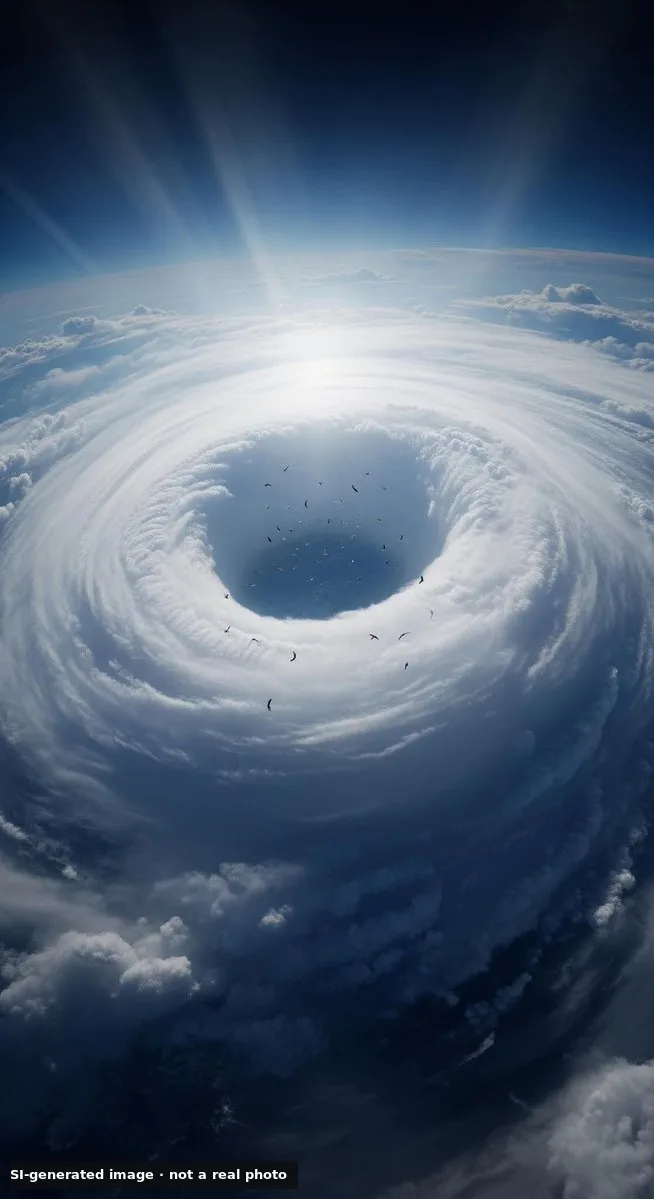
Result: 99% likely SI. The classifier found the statistical patterns of an SI-generated image in the pixels of this copy.
Metadata: JPEG, 654 by 1,199 pixels, about 75 KB, no camera EXIF data, no Content Credentials, no SI tag in the XMP. Nothing in the file says how it was made.
What the test covers: one copy of one image, as stored on Commons. We did not test screenshots of the posts, cropped versions or the Melissa videos mentioned below.
The detector and the meteorologists reach the same conclusion by unrelated routes, which is the useful part. A score alone is a probability about pixels. The scale of the birds is a fact about the world. When both point the same way, you can stop wondering. Who made the picture, and with which tool, remains unknown. No source we read identifies either.
A storm buried under fabricated footage
This image was one item in a much larger wave. The Weather Network reported on 28 October 2025 that generated images of Melissa were "inundating social media" and overshadowing safety information as the storm approached Jamaica. Many videos carried the watermark of Sora, OpenAI's video generator, and TikTok had removed at least two dozen fake videos. Jamaica's information minister, Dana Morris Dixon, told AFP she was aware of the fakes and urged people to listen to official channels.
Fact-checkers took on the most shared items one by one. Full Fact traced a viral video of the eye, apparently filmed through an aircraft window, to a TikTok post of 26 October whose caption said: "This is not real, it is a simulation made with ai for a 'what if' scenario". The account's bio read "AI disaster curiosity". Reposts dropped that sentence, the same loss of a label we followed in our fact-check of the Hollywood sign fire images. AAP FactCheck in Australia found Sora-watermarked clips shared with the words "praying for Jamaica", and a compilation stitched from older storms in Mexico, Vietnam, Myanmar and elsewhere. Full Fact also examined a picture said to show Black River Hospital destroyed. Google confirmed to them that it contained a SynthID watermark.
The damage ran in both directions. The Weather Network noted that the flood of fakes "appears to have left people questioning the validity of REAL videos", and gave as its example genuine footage from the Air Force's Hurricane Hunters. That is the cost a picture like the birds image leaves behind. It borrowed the crews' name to be believed, and the real crews were then believed a little less.
Why it worked
Three things combined. The story was true and freshly reported, so the picture had nothing to prove. The caption named a real, admired source. And the subject was not political: an image about animals in danger asks only for sympathy, so people share it without asking where it came from. Our fact-check of the viral baby peacock picture showed the same reflex with a gentler subject.
It also sits in an awkward category. Unlike the generated picture of a politician in floodwater after Hurricane Helene, it does not claim that something happened that did not. Birds were in the storm. The false part is the evidence. That makes it easy to defend ("it's just an illustration") and still a problem, because the post presented it as a photograph taken by named people during a live emergency.
How to check a storm picture
- Ask where the camera was. Every real photo was taken from somewhere: a plane at a known height, a satellite, a rooftop. If no camera could have been at that spot, stop there.
- Check the scale. Compare the size of small things with the size of big things. A bird, a car or a person visible next to a whole storm system is a warning.
- Go to the named source. If a caption credits the Hurricane Hunters, NOAA or a space agency, the picture should be on their official accounts with a date and a credit. If it is not there, treat the credit as decoration.
- Search for the image. A real storm photo has an origin. Our guide to reverse image search shows how to look for it.
- Add a detector as one more signal. You can run an SI check on a picture by uploading it or pasting its address. A high score on a clean copy is useful. A low score on a blurry screenshot proves nothing, and our guide on how to spot SI images explains why no single test settles the matter.
The birds deserved a better record than this. They were real, the storm that held them was real, and the only image most people saw of them was neither.