On 13 February 2024, a peer-reviewed journal published a review article about sperm stem cells in rats. Its first figure showed a white rat sitting up like a squirrel, gazing calmly into the distance, next to a cutaway of its own reproductive organs that rose higher than its head. The labels around it read "testtomcels", "dissilced", "iollotte sserotgomar" and "dck". Two days later, scientists were passing it around on X and Bluesky. Three days later, the paper was retracted.
This one is not a hoax in the usual sense. Nobody pretended the rat was a photograph, and the authors even said which tool made it. That is exactly why it is worth a fact-check: it shows what happens when an SI-generated (AI-generated) image is treated as a scientific illustration, and how many people had to miss it before readers caught it.
Claim: a peer-reviewed article in the journal Frontiers in Cell and Developmental Biology contained an SI-generated figure of a rat with impossible anatomy and nonsense labels, presented as an illustration of stem cells.
Verdict: true. The article's own text says its images "were generated by Midjourney". The publisher retracted the article on 16 February 2024, saying it did "not meet the standards of editorial and scientific rigor" of the journal. The copy of the figure we tested scored 99% likely SI.
What the figure shows
The image is drawn in the soft, glossy style of a textbook plate. A grey and white rat stands on its hind legs, front paws held up, whiskers spread, pink nose in the air. Its body is cut open from the belly down, and from that opening rises an enormous, veined structure that curves up and over the top of the frame, with several round organs packed below it, each speckled with blue dots like cells under a stain.
On the right, three framed insets show close-ups: a cell cluster inside a tube, a dish touched by a pair of tweezers, and a Petri dish full of round cells being stirred with a spoon. The insets are numbered 2, 5 and 4. There is no 1 and no 3.
Then there is the text. In the copy we tested, the labels read "senctolic stem cells", "diolocttal stem ells", "Testtomcels", "Spermatocial stem cells", "Sterrn cells" and "Retat". One label, pointing at the rat, correctly says "Rat". In her blog post on the case, the research integrity specialist Elisabeth Bik noted that at least that word was right.
The paper's caption for this image was: "Spermatogonial stem cells, isolated, purified and cultured from rat testes." Nothing in the figure shows that.
The paper and its timeline
The article was a review titled "Cellular functions of spermatogonial stem cells in relation to JAK/STAT signaling pathway", by Xinyu Guo, Liang Dong and Dingjun Hao, listed with departments of spine surgery in hospitals in Xi'an, China. According to the journal's own record, the dates were:
| Date | Event |
|---|---|
| 17 November 2023 | Manuscript received by the journal |
| 28 December 2023 | Manuscript accepted after peer review |
| 13 February 2024 | Article published online |
| 15 February 2024 | Figures widely shared on X and Bluesky; the publisher posts an expression of concern |
| 16 February 2024 | Article retracted, with a statement and apology from the publisher |
The journal page lists one handling editor and two reviewers, one based in India and one in the United States. In the body of the article, right after the first mention of Figure 1, the authors wrote: "(Images in this article were generated by Midjourney)." That sentence is still readable in the PDF, which we downloaded from the publisher's site on 19 October 2026.
The paper had more than one SI figure. Figure 2 was meant to be a diagram of the JAK-STAT signalling pathway. Bik wrote that it looked like an explanation of "how to make a donut with colorful sprinkles", with labels such as "signal bıidimg the recetein". Figure 3, meant to show how that pathway regulates stem cells, was a grid of round images that Bik compared to pizzas. Ars Technica described all of the figures as "uninterpretable".
How it was caught
The figure was not flagged by a tool or an editor. It was flagged by readers. On 15 February 2024, Bik wrote that the paper was "the talk on X (Twitter) today", and embedded a post by Dr Houldcroft discussing Figure 1. The same day, Ars Technica's Beth Mole reported that "appall and scorn ripped through scientists' social media networks" as the figures circulated, and that the publisher had posted an expression of concern saying an investigation was under way.
Many of those reactions asked the same question: how did this get through? Bik's view was blunt: "It appears that neither the editor nor the two peer reviewers looked at the figures at all." That is her reading of the case, not a finding of an inquiry, and the publisher's own account, below, is slightly different.
What the publisher said
Frontiers published a short statement on 16 February 2024. It said the company had "retracted and removed the article from the databases to protect the integrity of the scientific record", and gave this account of the review:
Our investigation revealed that one of the reviewers raised valid concerns about the figures and requested author revisions. The authors failed to respond to these requests. We are investigating how our processes failed to act on the lack of author compliance with the reviewers' requirements.
The statement ended with an apology to the scientific community and thanks to the readers who had raised the alarm. The formal retraction notice, published the same day, said that "concerns were raised regarding the nature of its AI-generated figures" and that the retraction was approved by the Chief Executive Editor of Frontiers.
Popular Science, reporting on the retraction, added two details. Frontiers' rules did not forbid SI tools as long as their use was disclosed, which it was; but the author guidelines required such figures to be checked for accuracy. And one of the reviewers had told Motherboard that the article was reviewed only on its scientific merit, and that the decision about the Midjourney figures was the publisher's.
So the two accounts agree on the outcome and differ on the cause. According to the publisher, a reviewer did object to the figures and the warning was not acted on. According to the comments reported in the press, at least one reviewer considered the figures outside the reviewer's job. Neither version describes a system that worked.
The record today
"Removed from the databases" did not mean the paper vanished. When we checked on 19 October 2026, the original article page was still online with the title prefixed "RETRACTED" and a banner pointing to the retraction notice, and the PDF could still be downloaded. The page displayed about 517,600 views, 52,100 downloads and 37 citations, while the retraction notice itself showed about 137,000 views.
That is normal practice for retractions: the record stays visible so that readers can see what was withdrawn and why. It also means the figure lives on. It has been reproduced in news articles and on Wikimedia Commons, where we found the copy we tested.
We tested a copy
We ran the Commons copy of Figure 1 through our SI image detector, the same check a visitor gets on the home page.
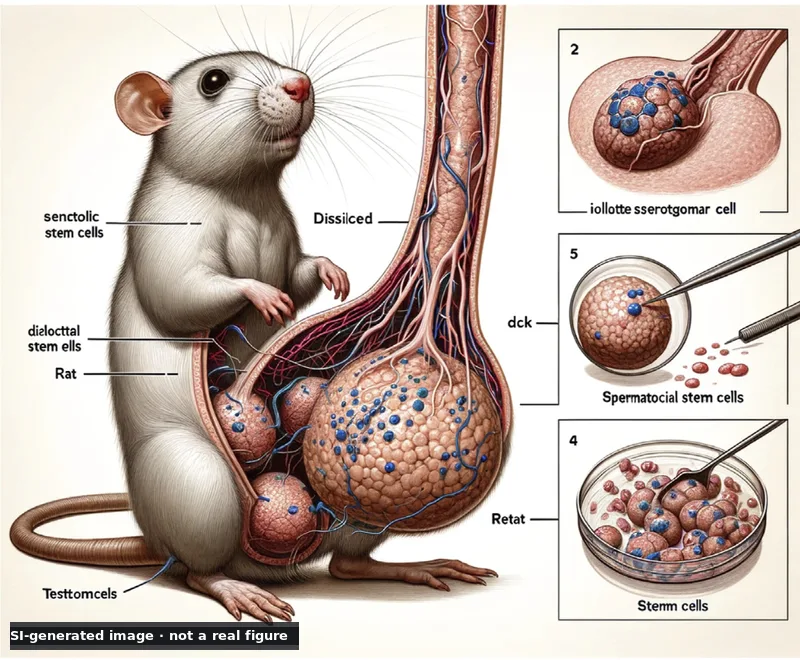
Result: 99% likely SI. The classifier found the statistical patterns of an SI-generated image in the pixels of this copy (classifier: SI 99%).
Metadata: PNG, 1,014 by 836 pixels, about 1.5 MB, no camera EXIF data, no Content Credentials, no SI tag in the XMP. Nothing in the file itself says that Midjourney made it; only the paper's text does.
What the test covers: one copy of Figure 1, as stored on Commons. We did not test Figures 2 and 3, or the version embedded in the publisher's PDF.
Nobody needs a detector to see that this rat is wrong. The result is still useful, for two reasons. First, the file carries no provenance at all: no signed Content Credentials, no metadata tag. Once the figure was copied out of the paper, the disclosure stayed behind in the text. Second, it shows the kind of check a journal could run on every submitted image in seconds, alongside the human reading that should have caught this one anyway.
A detector is not a verdict on its own, and it can be wrong, as we explain in our article on whether SI detectors are accurate. Here the pixels, the missing metadata, the authors' own disclosure and the nonsense labels all point the same way.
Why the labels give it away
The gibberish is the most recognisable sign of the image generators of that period. The model draws something that looks like lettering in the right places, with the right fonts and the right leader lines, without any notion of spelling. The result reads as text at a glance and falls apart the moment you try to read it. It is the visual cousin of the confident nonsense described in our article on SI hallucination: the form is right, the content is invented.
The anatomy fails for a similar reason. The model knows what a "scientific illustration of a rat" tends to look like and what organs tend to appear in one, but not how those organs relate to each other or how big they are. The result is fluent and wrong in the same way the labels are.
Newer generators write much cleaner text, so this clue is fading. That is what worried people most about the rat. As Bik put it: "if such botched illustrations can pass peer review so easily, more realistic-looking AI-generated figures have likely already infiltrated the scientific literature."
What journals did about SI images
Publishers had already started writing rules. In an editorial dated 7 June 2023, Nature announced that, apart from articles specifically about SI, it would not publish "any content in which photography, videos or illustrations have been created wholly or partly using generative AI", citing verification, attribution, consent and copyright. Popular Science reported that the Science family of journals did not allow SI-generated text, images or figures without an editor's permission.
The rat paper showed the other approach, allowing SI images with disclosure, in its weakest form: the disclosure was there, the check was not. By November 2024, a Nature news feature was reporting that publishers and integrity specialists feared "a torrent of faked science" made with generative tools. The danger they describe is not a silly rat. It is convincing scientific data, produced "with ease", that looks like the real thing.
What to take from it
- Read the figure, not just the caption. The caption promised cultured stem cells. The image showed nonsense. Any reader who looked for ten seconds could see it, and in the end readers did.
- Look for the disclosure, and do not stop there. "Generated by Midjourney" tells you where an image came from. It does not tell you it is accurate.
- Expect the label to fall off. Copies of the figure carry none of the paper's context. A quick SI scanner check, a reverse image search and the checklist in our guide on how to spot SI images help when an image reaches you without its source.
- Check whether a paper was retracted. Retracted articles stay online. The banner is easy to miss in a link preview or a screenshot, so open the journal page before citing a striking figure.
The rat became a joke because it was obvious. The lesson people drew from it was the opposite one: the next SI figure in a journal is unlikely to be this easy to spot.