
A crowd of workers kneels around a trench in a green field. In the trench lies a human skull the size of a small car, its teeth as big as bricks. Nobody holds a trowel, a brush or a measuring stick. The caption says archaeologists have just found the remains of a giant, and that the authorities want to keep it quiet.
Pictures like this one have circulated for more than twenty years. The first famous version was made in Photoshop in 2002 for a hoax contest. The latest ones are made by SI (AI) image generators, in seconds, and they are posted by Facebook Pages that live on clicks. The claim has not changed. Only the tool has.
Claim: photos show archaeologists unearthing the skeletons or skulls of ancient giant humans, in India, Saudi Arabia, Ohio, Ethiopia, Sri Lanka, Crimea or elsewhere.
Verdict: false. No such discovery has been documented. National Geographic, Reuters, PolitiFact, Snopes and Lead Stories have traced the best-known pictures to Photoshop contest entries, and fact-checkers in India and the United States have identified the newer wave as SI-generated. An example of the genre we tested scored over 99% likely SI.
The original: a Photoshop contest entry from 2002
The picture that started the modern wave shows a reclining skeleton in a dig, a wooden platform around it and a man with a shovel for scale. In 2007, National Geographic News traced it to Worth1000, a website that ran photo manipulation contests. It was made by a Canadian illustrator using the name IronKite, and it placed third in a 2002 contest called "Archaeological Anomalies 2", which asked entrants to create a hoax archaeological discovery.
IronKite told the magazine how he did it. He started from an aerial photo of a mastodon excavation in Hyde Park, New York, and laid a human skeleton over the animal's bones. National Geographic dates that dig to 2000; a 2022 PolitiFact article dates it to 2004. The man with the shovel was the hardest part: the blade looked as if it sat inside the skull, so he removed it. "If you look, he's holding a yellow-handled shovel, but there's nothing on the end," he said. The whole picture took about an hour and a half.
By 2004, National Geographic reported, the image was being blogged and emailed around the world. In March 2007, an Indian monthly, Hindu Voice, printed a story claiming that a National Geographic team working with the Indian Army had dug up a giant skeleton in northern India. Its editor admitted to National Geographic that the publication had been taken in and said it had printed a retraction. Another version moved the same find to Saudi Arabia, with an oil exploration team uncovering a skeleton 60 to 80 feet long.
The magazine said it was still receiving emails about the giant from Portugal, India, El Salvador, Malaysia, Egypt, Kenya and other countries, all asking the same question: is it true? It is not. The National Geographic Society has not discovered ancient giant humans.
One hoax, many sequels
The contest format produced more giants. In December 2021, Lead Stories traced another viral skeleton to a 2011 Worth1000 contest called "Size Matters 4". The brief asked designers to change the size of something "in a way that is extraordinary, but not impossible", and warned that "the trick in making a successful hoax is believability". The entry, by a designer posting as Whitmath57, was shared in a Facebook group about space and aliens with the Worth1000 watermark still visible in the lower left corner.
Reuters had already debunked the same picture in March 2021, in posts shared in Facebook groups of flat earth believers. It also identified a second image as a composite: a photo of an old but normal-sized female skeleton combined with a photo of archaeologists excavating a dinosaur fossil in 2013, first seen on a Bosnian website in 2015. Reuters noted that some of these groups tie the giants to the Nephilim of the Hebrew Bible, and claim the Vatican is hiding the evidence.
Giant stories are much older than the internet. PolitiFact, checking an Instagram post about "giant human caucasian skeletons in Ohio" in September 2022, cited the Columbus Dispatch: reports of giant skeletons in Ohio go back to at least 1845. One of them came from John Everhart, who excavated Brush Creek Mound in Muskingum County in the late 1800s and claimed he had found skeletons over 8 feet tall and a slab carved with hieroglyphics. A worker later testified in court that he had been promised $15 to carve the "ancient" inscription. Alex Boese, of the Museum of Hoaxes, told National Geographic that fake giants go back to at least the 1700s, and pointed to the Cardiff Giant, a stone figure "found" in New York State in 1869.
The SI wave: from Photoshop to prompts
A Photoshop giant took skill and an afternoon. An SI giant takes a sentence. Since 2023, fact-checkers have been dealing with a new generation of pictures that nobody edited by hand.
- The giant in the street (July 2023). Snopes looked at a grainy "old photograph" of a giant walking through a crowd, posted on X with a story about giants once working in English villages. It had passed 3.5 million views. The earliest copy Snopes found was a Reddit post of 26 April 2023 in a forum for Midjourney creations, captioned "The last of the giants being paraded through the streets circa 1890". Snopes pointed out warped faces in the background, a child with one leg and no hands, and figures with three or four fingers.
- Giant skulls (February 2024). Factly, in India, checked a series of images of huge skulls said to be recent finds. One came with a story about an ancient "City of Giants" in eastern Ethiopia. A forgotten city was indeed found there in 2017, Factly noted, citing the BBC, but the researchers had dismissed the local legend of giants, and no report of that discovery showed giant skulls. The people in the viral images had the deformities typical of generated pictures.
- Sri Lanka (April 2024). The Quint traced two pictures of a skeleton surrounded by people, shared as a find of giants' skeletons in a village, to a Facebook user whose profile described them as a "digital creator". One of the posts carried the hashtag "#ai_image". The skeleton had a different number of fingers on each hand, and one woman had an extra hand behind her.
- Crimea (April 2024). Lead Stories followed a post by a Facebook Page called Mystical Archeology announcing "Tombs of Giants found in Crimea". The link in the comments led to a recycled article full of homoglyphs, characters that look like normal letters but defeat plagiarism checks, on a site that showed a fake Flash Player update. One of the pictures was derived from a real 2019 dig at the ancient Greek city of Phanagoria, across the Kerch Strait, where archaeologists had found the graves of a family: a man, a woman and three children. Ordinary people, not giants.
The pattern is the same as in our fact-check of the Shrimp Jesus images: the picture is bait. It travels on curiosity, piety or outrage, and the clicks go to pages full of ads. Nobody behind these posts needs you to believe in giants. They need you to share.
We tested an example of the genre
The viral posts above were shared as screenshots and reposts, and we did not find a copy with a clear free licence. Wikimedia Commons does host a picture of exactly this kind: a "fake photo of a giant skeleton excavation" made with Midjourney and uploaded in June 2024 by a Commons contributor. To be clear, it is not one of the posts the fact-checkers examined. We ran it through our SI image detector to see what a visitor gets on a picture of this type.
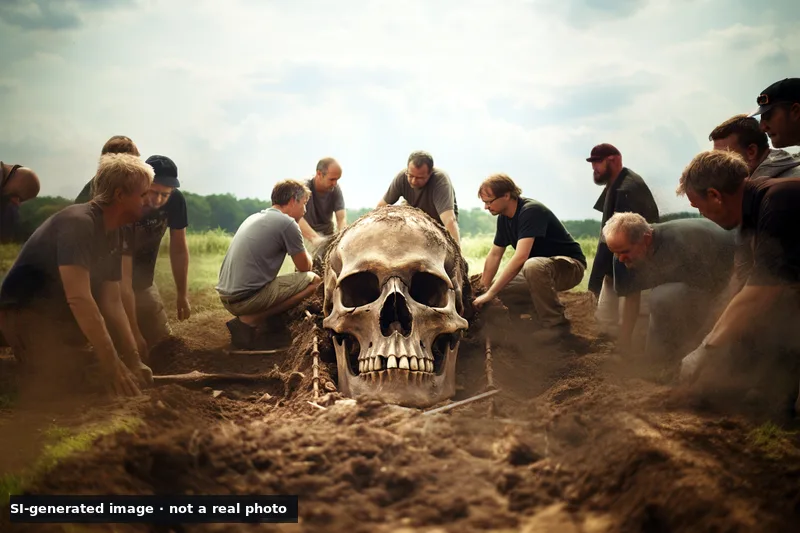
Result: over 99% likely SI. The classifier found the statistical patterns of an SI-generated image in the pixels (classifier: SI over 99%).
Metadata: PNG, 1,023 by 682 pixels, about 990 KB, no camera EXIF data, no Content Credentials. The XMP metadata still carries an IPTC tag, digitalSourceType "trainedAlgorithmicMedia", the standard label for media made by a trained algorithm.
What the test covers: this one Commons file. We did not test the images from the Sri Lanka, Crimea, Ethiopia or street giant posts.
Two things are worth noticing. First, this file still says what it is: the metadata tag survived the upload to Commons. A picture copied from a Facebook post or taken as a screenshot usually arrives without that kind of label, and then only the pixels and the context are left to check. We explain how such labels work, and why they fall off, in our article on C2PA and Content Credentials.
Second, you do not need a detector to doubt this picture. Look at it the way an archaeologist would:
- The scale does not add up. The skull is enormous, but the bones that run from it look like thin sticks of ordinary size.
- There is no excavation. Real digs have straight trench walls, grids, labels, buckets, brushes and a scale bar in every photo. Here, a dozen people kneel in loose earth with their bare hands.
- The people are generic. The same rumpled T-shirts, the same poses, faces that blur in the dust. Nobody takes notes, nobody holds a camera.
- The story has no trail. A find like this would come with a museum, a university, a named team and a published paper. Every fact-check above ends the same way: there is none.
Why the giants keep coming back
David Mikkelson, of Snopes, gave National Geographic a short explanation in 2007: hoaxes succeed when they seem to confirm something people already want to believe, and when they come "in a framework that has the appearance of credibility". The ancient giant, he said, "appeals to both a religious and a secular vision of the world as different and more fantastic than mere science would lead us to believe". The proof "comes in the form of a fairly convincing image".
SI makes that image cheap. The 2002 skeleton needed a source photo, a human skeleton and ninety minutes of careful work, and it still had a shovel with no blade. A generated picture needs none of that, and a Page can post a new "discovery" every day, in any country, with fresh faces in the crowd. That is why the same claim now turns up dressed as a Sri Lankan village, an Ethiopian city or a Crimean tomb.
It also changes how fact-checkers work. With a Photoshop fake, the winning move was to find the original: the contest entry, the mastodon dig, the dinosaur photo. A generated picture has no original to find. A reverse image search may still lead to the first post, as it did for Snopes with the Reddit giant, but often the trail stops at a Page that makes its own images.
How to check the next giant
- Ask who found it. Real archaeology has names: a university, a museum, a heritage agency, a journal. "Archaeologists in shock" is not a source.
- Look for the dig. Tools, trench walls, a scale bar, labels on finds. Generated scenes often skip them, or render them as shapeless clutter.
- Count the fingers and the faces. Fact-checkers caught the Sri Lanka and street giant images on hands and faces in the background, exactly as our guide on how to spot SI images suggests.
- Follow the link, carefully. If the "details in comments" lead to an ad-heavy site asking you to update a plug-in, close it.
- Run a quick check. An SI detector gives you one more signal, especially when the file still carries metadata. It does not replace the questions above, and a score is never proof on its own, as we explain in our article on whether SI detectors are accurate.
If you want to test your own eye before the next post lands in your feed, try the SI or Not game. The giants, so far, have always lost.