SI Video Detector (beta) Is this video SI (AI)-generated?
Upload a clip and get the probability that it was generated by SI (AI) video models such as Sora, Veo, Runway or Kling. We read the file's Content Credentials and metadata, score eight frames spread across the video and show every clue. Free, no credit card, video deleted after analysis.
Uploading and analysing...reading metadata, extracting 8 frames and classifying each one (up to 30 seconds)
How this SI video detector works
Part of the SI detector suite, the video tool is a beta built on the same two layers as our SI image detector, adapted to moving pictures.
Signatures and metadata. We read what the file says about itself. Content Credentials (the C2PA standard) are signed records that some generators attach to their exports, and they can name the tool that made the video. We also look for synthetic media flags (the IPTC "trainedAlgorithmicMedia" source type), generator names in container tags, and the tags that phones and cameras write when they record: device make and model, OS version, sometimes location.
Frame analysis. We extract eight still frames spread across the video, skipping the very start and end where titles and fades usually sit. Our own classifier, trained on real photographs and on images from generation models, gives each frame an SI probability. You see all eight scores, because a video can mix real and generated shots.
The two layers are merged into one number. A signed credential naming an SI generator pushes the score very high on its own. Genuine phone recording tags pull it down a little, since generators do not write them, although they can be copied. Everything else comes from the frames: we average their scores and tell you how many lean SI.
What it can catch
The detector works best on the kind of video that is fully generated from a text prompt or an image: short photorealistic clips from Sora, Veo, Runway, Kling, Pika, Luma and similar tools. Two situations give the clearest answer:
The original export, with its credentials. OpenAI attaches C2PA Content Credentials to Sora videos, and we have seen signed credentials in clips exported from Runway too. When they survive, the result names the generator and the signature is shown in the metadata panel.
Clips that are generated from start to finish. When every frame comes from a model, the frame classifier has eight chances to spot the statistical patterns of generated imagery, and the scores tend to agree.
What it cannot catch (yet)
This is a beta, and we would rather list its blind spots than let you over-trust it.
Invisible watermarks. Google marks Veo videos with SynthID, and other companies use their own hidden marks. Only their owners can read them; we cannot. Our article SynthID explained covers how these watermarks differ from Content Credentials.
Re-encoded videos. A clip downloaded from TikTok, Instagram, X or WhatsApp has been re-compressed, and its credentials and tags are gone. Only the frame analysis is left, on degraded pixels.
Deepfakes and face swaps. A face swap or a lip-sync fake is usually a real video with one altered face. We analyse whole frames, not faces, and we do not check whether lips match the audio. Such videos are not specifically detected.
Partial edits. One generated shot inside a real edit, generated backgrounds, or objects added with an editing tool may be missed if our eight frames fall elsewhere.
Motion and sound. We do not analyse movement, physics or the audio track. Many giveaways of generated video live there, so watch the clip yourself too.
Styles outside photorealism. Cartoons, anime, 3D renders and heavy filters are frequently misread in both directions, as they are for still images.
How to read the score
The number is a probability, not a share of the video that is SI. Above roughly 70% we say Likely SI-generated, below 30% Likely real footage, and in between Uncertain. Look at the frame strip as well: eight frames that all lean SI tell a different story from two outliers in an otherwise real clip. We do not publish an accuracy figure for the beta, because it would depend entirely on the videos it was measured on.
How to read the SI score: 0 to 30% likely real or human, 30 to 70% uncertain, 70 to 100% likely SI. The number is a probability, not a share of SI content.
Check a video yourself
A detector is one clue. Before sharing or believing a surprising clip, also:
Find the first upload. Who posted it, when, and with what context? Generated clips often appear without a source.
Take screenshots of key frames and run a reverse image search. Real events usually leave other photos and angles.
Watch for physics that breaks: objects that merge or vanish, hands and fingers that change shape, text on signs that turns to gibberish, reflections and shadows that disagree.
Listen closely: generated or cloned voices can sound flat, and room sound may not match the scene.
Upload the original file if you can get it, rather than a re-shared copy.
Your video is stored outside the web server under a random name, analysed, then deleted. We log the score and the technical clues, never the video and never your IP address in clear text. Small still frames are kept for one hour so you can see them in the result, and longer only if you choose to share it. Details on the privacy page.
Frequently asked questions
Is this video AI? How does the SI video detector work?
It combines two checks. First it reads the file itself: C2PA Content Credentials, synthetic media flags, container tags and phone or camera recording tags. Then it extracts eight still frames spread across the video and runs our own image classifier on each one. The final probability merges both, and every clue and every frame score is shown so you can judge for yourself.
Can it detect Sora, Veo, Runway or Kling videos?
Often, but not always. Videos exported from Sora or Runway may still carry signed Content Credentials that name the generator, which is the strongest signal we can read. Without metadata, the frame classifier is the only signal, and it works best on photorealistic clips. Stylised, animated or heavily compressed videos are harder, and new generators can slip through.
Does it detect deepfakes?
Not specifically. A face swap or a lip-sync deepfake is usually a real video with only the face altered, and our frame analysis looks at whole images, not at faces or at how lips match the audio. A deepfake may be flagged or may pass. Treat a low score on a suspected deepfake as "not proven", never as "authentic".
Can you read SynthID or other invisible watermarks?
No. SynthID, used by Google for Veo videos, and similar invisible watermarks can only be checked with the tools of the company that embedded them. We read open, standard metadata such as C2PA, not proprietary watermarks.
Why did my video lose its metadata?
Social networks and messaging apps re-encode every upload, and most editors re-export files without the original tags. Content Credentials, phone tags and generator tags are usually gone after that. Upload the original file when you can: it gives the detector much more to work with.
What files are accepted, and does it cost anything?
MP4, MOV, WebM and M4V files up to 100 MB and 3 minutes, uploaded from your device or fetched from a direct link to the file. YouTube, TikTok and Instagram page links are not supported. A video check uses 5 credits (an image uses 1): your first 3 checks need no account, a free account gives you 10 credits a month, Pro 250 and Max 1,500, and credit packs add credits that never expire.
Is my video stored?
No. The video is written to a private folder with a random name, analysed, then deleted. We keep the score, the clues and small still frames for one hour so you can see them; the frames are kept longer only if you choose to share the result, and the share link expires after 7 days.
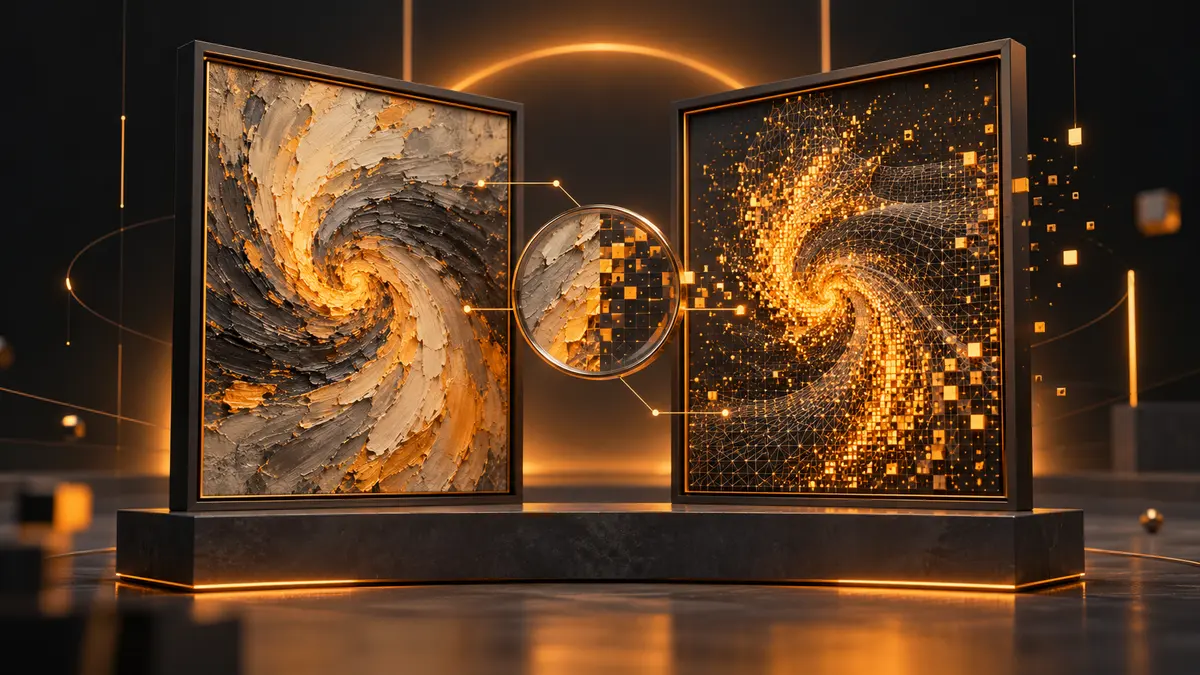
People guess barely better than chance, and detectors trained on photos stumble on drawings and paintings. Here is what the research says, which clues really help, and how our own detector did on eleven artworks.
C2PA Content Credentials are signed provenance data that record which tool made a file and how it was edited. Here is how they work, how to check them, and what happened when we removed them from ten ChatGPT photos.
Cloned voices, generated profile photos and SI-written messages give old scams new disguises. Here is what the FBI, the FTC and Europol document, what our detector could and could not catch, and the checks that actually protect you.