In March 2024, a very strange kind of religious art started filling Facebook feeds. Jesus with shrimp for arms, hovering over a bay full of fishing boats. Jesus floating underwater, his legs turning into a tail. Jesus built from crabs, worshipped by other crabs. The pictures collected hundreds of thousands of reactions, and many of the comments under them simply said "Amen".
None of them is a photograph of anything. "Shrimp Jesus" is a family of SI-generated (AI-generated) images, and it became the best known example of a business model: Facebook Pages that post synthetic pictures by the hundred to grow an audience, then point that audience towards ad-filled websites, fake products or worse. The pictures are absurd on purpose. The system behind them is not a joke.
Claim: the "Shrimp Jesus" pictures shared by Facebook Pages in 2024, and the similar posts captioned "Made it with my own hands", show real artworks, sculptures or scenes.
Verdict: false. AAP FactCheck concluded on 26 April 2024 that these images "are not real" and were generated using SI. Researchers at the Stanford Internet Observatory and Georgetown University traced them to networks of spam and scam Pages. The copy we tested scored 99% likely SI.
What the picture shows
There are many Shrimp Jesus images, and they do not all look alike, so we describe the one we tested. It is a wide underwater version, a file of 1,900 by 1,140 pixels, and one of the two Shrimp Jesus pictures that The Guardian used to illustrate an article on 19 May 2024.
A bearded man with long hair, styled like a classic statue of Jesus, floats in clear blue water with his arms spread wide. Behind his head hangs a thin metal ring crossed by two bars, a wireframe version of a halo. From the neck down he is a shrimp: an orange, segmented shell over the chest and arms, a curled tail where the legs should be, and long, jointed shrimp legs sticking out of his sides. Thin antennae trail away to the left and right. A shoal of small grey fish fills the right half of the frame.
The face and hands are smooth and pale, like painted plaster, while everything else is shell. There is no aquarium glass, no diver, no credit. It is a rendering of an idea, not a record of a moment.
Where Shrimp Jesus came from
Jason Koebler of 404 Media had been reporting on SI images flooding Facebook since December 2023. On 19 March 2024 he wrote that "last week the world was introduced to Shrimp Jesus, a series of AI-generated images in which Jesus is melded with a crustacean, and which have repeatedly gone viral on Facebook." Shared outside Facebook, they mostly drew disbelief: Koebler quoted a viral post that read "WHAT IS HAPPENING ON FACEBOOK".
The same day, NBC News described the wider scene: "Extremely muscular cows. Sharks leaping out of a muddy sea. Shrimp Jesus." Its reporter, Angela Yang, found that most of these images came from dozens of Pages posting "nearly every hour of the day", with recurring themes. Jesus was rendered in plastic bottles, sand and fruit, and more recently in sea creatures: "mainly shrimp, crabs and sea horses."
A day earlier, on 18 March 2024, the Stanford Internet Observatory had published the research behind much of that coverage. Its summary includes the line "Behold, Shrimp Jesus" and lists relatives: Crab Jesus, Watermelon Jesus, Fanta Jesus and Spaghetti Jesus.
Who generated the image we tested, and with which tool, is not known. Wikimedia Commons lists its author as unknown and its date only as "before 19 May 2024". No source we read identifies the original Page.
The research: 125 Pages and hundreds of millions of reactions
The study behind the Stanford post was written by Renée DiResta of the Stanford Internet Observatory and Josh A. Goldstein of Georgetown University's Center for Security and Emerging Technology. It first circulated as a preprint covering 120 Pages, the figure NBC News reported. The final, peer-reviewed version appeared in the Harvard Kennedy School Misinformation Review on 15 August 2024 and covers 125 Facebook Pages that had each posted at least 50 SI-generated images.
Some of its figures:
- As of April 2024, the Pages had a median of 81,000 followers.
- The images "collectively received hundreds of millions of exposures". In the third quarter of 2023, a post with an SI-generated image was among Facebook's 20 most viewed posts, with 40 million views and more than 1.9 million interactions.
- The most common themes were houses or cabins (43 Pages), children (28 Pages), wood carvings (19 Pages) and Jesus (13 Pages).
- One image of "Jesus rendered as a crab worshiped by other crabs" carried the caption "Made it with my own hands!" and received 209,000 reactions and more than 4,000 comments.
The authors sorted the Pages into spam (clickbait pushing people to outside websites, or fake follower growth), scams (stolen Pages, false identities, fake products) and "other creators" who posted synthetic images without saying so. Their conclusion on motive was blunt: these operators seemed "motivated by profit or clout, not ideology."
That is why Shrimp Jesus is worth a fact-check. It is not political disinformation. It shows what cheap image generation is used for on a large platform, every day.
Why such an obvious fake still works
The Stanford researchers made a point that is easy to miss. In their words, Shrimp Jesus is "(perhaps) obviously an artistic fantasy", created by a Page that had previously shared clickbait links to a content farm. The images that worried them more were the ordinary ones: housewares, homes, and "artwork purportedly created by children". Comments on those suggested that many users had no idea the pictures were synthetic.
The captions are built for the same purpose. The paper lists phrases that repeated across unrelated Pages: "No one ever blessed me" under pictures of old people, amputees and infants, "Made it with my own hands" under woodwork and drawings that do not exist, and "This is my first cake! I will be glad for your marks", which openly asks for feedback. AAP FactCheck noted another recurring theme: very old people celebrating birthdays with cake, at ages above that of the oldest person then alive, 117-year-old Maria Branyas Morera.
The feed did the rest. Meta's own reports, as compiled in the study, show that the share of Feed views coming from "unconnected posts", from sources a user does not follow, rose from 8% in the second quarter of 2021 to 24% in the third quarter of 2023. The researchers suspect the recommendation system promoted these images because they generated engagement. Koebler reached the same conclusion from months of reporting: the spam pages were "being rewarded by Facebook's recommendation algorithm."
Stolen Pages and scripted comments
The study found that 50 of the 125 Pages had changed their names, often from a completely different subject. One, created in 2011 as "Rock the Nation USA" for a touring band with about 9,400 followers, was renamed "Life Nature" on 29 December 2023 and started posting SI images. Between 31 December and 6 January it gained 328,900 new followers. The band's booking agent told Koebler the Page had been hacked.
NBC News found a Page still named after the Davie High School War Eagle Bands in North Carolina, by then full of SI images of Jesus. A spokesperson for Davie County Schools said it "was hijacked from our high school band".
The comment sections were not entirely human either. NBC found replies from new accounts with no posts, offering friendship to commenters with the same script ("Hello, Honestly I'm really impressed with your profile and personality"). The study describes scam accounts that engaged with "credulous commenters", at times seeking personal information or offering to sell products that do not exist.
So the real risk of Shrimp Jesus is not that you believe in the shrimp. It is that you reply "Amen", get noticed, and receive a friendly message from a stranger a few hours later. We covered the follow-up step, from fake profiles to fake photos and cloned voices, in our guide to SI scams.
We tested a copy
A copy of the picture is stored on Wikimedia Commons under the name "Facebook AI slop, "Shrimp Jesus" 1.jpg". It was uploaded on 4 October 2024, is described as a Shrimp Jesus "uploaded to Facebook, and used as an example of AI slop by the Guardian", gives The Guardian's article as its source and lists the author as unknown. It is tagged as public domain because it was produced by software. On 15 October 2026 we ran that file once through our SI image detector.
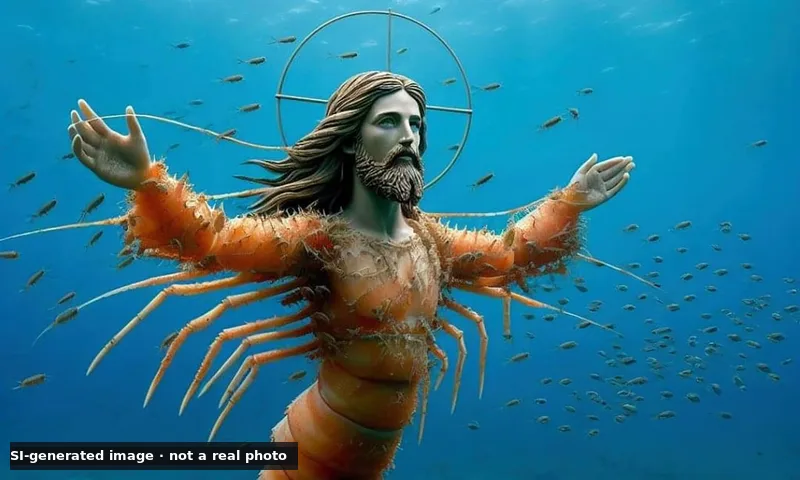
Result: 99% likely SI. The classifier found the statistical patterns of an SI-generated image in the pixels of this copy.
Metadata: JPEG, 1,900 by 1,140 pixels, about 370 KB, no camera EXIF data, no Content Credentials, no SI tag in the XMP. Nothing in the file says how it was made.
What the test covers: one copy of one Shrimp Jesus image, as stored on Commons. We did not test the other versions, screenshots of the original posts or the crab Jesus picture described in the study.
Nobody needs a detector to see that this is not a photograph. The test matters for another reason: the file carries no label at all. Meta announced on 5 April 2024 that it would label SI images when it detects "industry standard" indicators embedded by generators, described in our explainer on C2PA and Content Credentials, or when the uploader discloses it. This copy has none of those indicators, so a label that depends on them has nothing to read.
What platforms and fact-checkers did
Meta told the researchers by email on 10 April 2024 that it had reviewed the Pages in their report, "taken action against those engaged in inauthentic behavior", and demoted the clickbait sites under its Content Distribution Guidelines. In its 5 April announcement, it said it planned to start labeling organic SI content in May 2024, with "Made with AI" labels, later renamed "AI info" in an update dated 1 July 2024.
Fact-checking reached only a few pictures. The study found one image from a Page called "Interesting Stories", with more than a million engagements, labeled "False information" on Facebook after a fact-check by Congo Check. The authors noted that "dozens of similar images from other Pages are not labeled", which shows how hard it is to check generated images one by one when they are produced by the thousand.
In Australia, AAP FactCheck took the whole genre as its subject. It reported that none of the Pages carried disclaimers and that the most prolific ones did not answer its questions. Jeannie Paterson of the University of Melbourne's Centre for AI and Digital Ethics added a warning that applies well beyond Facebook: "On a casual viewing, many are indistinguishable."
By May, The Guardian had a word for it. Its article of 19 May 2024, illustrated with Shrimp Jesus pictures, explained "slop": SI-generated material that nobody asked for, put online mostly to collect advertising revenue. In the same piece, Koebler called the result a "zombie internet", an idea we examined in our article on the dead internet theory.
How to deal with Shrimp Jesus and its cousins
- Look at the Page, not the picture. The study found Pages that used to belong to a band, a church in Georgia and a windmill seller. A Page whose name or subject suddenly changed, and which now posts surreal art every hour, has probably changed hands.
- Read the caption against the image. "Made it with my own hands" under a sculpture no human could build, or a birthday cake for a 122nd birthday, is a script, not a story.
- Do not reply to the bait. Comments are what these Pages harvest, and a stranger who answers yours with a compliment is following a script. AAP FactCheck's advice was to report the content or ignore it.
- Check the ordinary images too. The craft project, the cabin and the child's drawing are the ones that fool people. A free SI detector gives you one more signal on a clean copy, a reverse image search often shows the same picture on dozens of Pages, and our guide on how to spot SI images lists what to look for with your own eyes.
Shrimp Jesus became a meme because it was funny. The Pages that posted it were not trying to be funny. They were testing what the feed would reward, and the answer, for a while, was almost anything.