In the spring of 2023, a picture of a tiny bird with a cobalt head, one huge glossy blue eye and a wing of miniature peacock feathers started doing the rounds with a simple caption: a baby peacock. It was shared as a moment of cuteness, not as news, and that is exactly why it travelled so far. No such bird exists. The picture was produced by an SI (AI) image generator and offered on a stock image site, where it was labelled as generated.
This case has no villain and no victim in the usual sense. It earns its place in this series for another reason: the fake did not stay on social media. It moved into image search, where people go to find out what a baby peacock looks like.
Claim: a photo shows a real baby peacock with bright blue feathers.
Verdict: false. The image is SI-generated. Snopes rated it "Fake" on 15 August 2023 and NewsMeter rated the claim false two days later. Real peafowl chicks are brown.
What the picture shows, and what a real peachick looks like
The viral image is a square close-up. A fluffy chick stands on bare ground, turned to the left, next to a pink flower bud and a few round green leaves. Its body is covered in beige down, its head and throat are metallic blue, its eye is oversized and blue, and its wing carries a patch of blue, gold-rimmed feathers that look like a shrunken version of an adult male's train. It is an adult peacock's colour scheme painted onto the body of a chick.
A young peafowl is called a peachick, and it looks nothing like that. The bird reference site Birdfact describes newly hatched peachicks as covered in light brown fluffy down with striped wing feathers, closer to a baby pheasant than to the adult bird, and says males and females are virtually impossible to tell apart at that age. The Los Angeles County Arboretum, home to a large free-roaming flock, writes that at around two months of age both male and female peachicks have the same colouring as the peahen, which it describes as mottled brown with a green neck, and that a male only gets his mature colouring at about two years.
| Feature | Viral image | Real peachick |
|---|---|---|
| Down | Beige body, bright blue head and throat | Light brown, fluffy (Birdfact) |
| Wings | Blue feathers with gold rims | Striped, like a young pheasant (Birdfact) |
| Sexes | Looks like a miniature adult male | Males and females look alike (Birdfact) |
| Adult colours | Already present on a chick | At about two years for males (LA Arboretum) |
Birdfact now carries a section titled "What does a baby peacock not look like?", which reproduces the viral picture and states that it was produced by an image generator. A bird guide had to add a paragraph about a bird that does not exist.
How it spread in 2023
Snopes dates the start of the wave to around April 2023. The post most often quoted was published on X, then still called Twitter, on 23 April 2023, with the words "Your cuteness for the day" and "A baby peacock". By mid-August, according to the entertainment site Sportskeeda, that single post had passed two million views.
Snopes also found it on Facebook, TikTok, Instagram, LinkedIn, YouTube, Reddit and the Chinese platform Weibo.
The most instructive account comes from someone who studies this for a living. On 6 August 2023, Emily M. Bender, a professor of linguistics at the University of Washington and a well-known critic of generative SI, wrote that she had seen the bird while scrolling Facebook on her phone, thought "Adorable!" and clicked share. Two friends quickly told her it was synthetic, and she removed her share. She noted that the fake was plain to see on her laptop screen and much less so on a phone.
She also noticed where the post came from. It appeared in her feed under the name NATIONAL GEOGRAPHIC, a source she would normally trust on the natural world. It was not the magazine: it was a Facebook group that had taken the name. A trusted label had been borrowed, and on a phone screen nobody reads the About panel.
How the fact-checkers settled it
This is one of the rare cases where the fake came with its own label, much like the generated pictures of Donald Trump's arrest, whose author had said what they were. Here the label sat on a stock image site instead of in a tweet.
Snopes found the picture in Adobe's stock media library, where it was labelled as a generated image. NewsMeter, an Indian fact-checking outlet, reached the same listing by a different road: its fact-checker noticed the chick's slightly distorted feet, ran a reverse image search and landed on Adobe Stock. That is the method we describe step by step in our guide to reverse image search, and it took one search to find the origin.
Both then added independent checks:
- Anatomy. Snopes pointed to the bird's "weirdly deformed toes", NewsMeter to its distorted feet.
- Biology. Snopes cited the Los Angeles County Arboretum: peachicks are mottled brown at around two months, not blue.
- A detection tool. Snopes ran the picture through a commercial detector, which returned a 99.8% probability that it was generated.
- The crowd. Sportskeeda reported that a context note had been attached to the April post on X, saying the image was digitally produced and that peachicks "resemble small game birds".
One thing remains unknown. None of the sources we read names the generator that produced the picture, and the Wikimedia Commons page for the file lists the software as unidentified. We also tried to open the Adobe Stock listing ourselves on 9 October 2026 and got an error page, so the stock site label is something we report from Snopes and NewsMeter, not something we saw.
From social feeds to search results
The second half of Bender's account is the part that aged best. Having been fooled, she did what a careful reader does: she searched for what baby peacocks really look like. In Google Images on 5 August 2023, the first result was the same fake picture, and several other results looked similarly fake to her. The result pages came from social networks, stock libraries, a prompt-sharing site and a few bird sites. She ended up trusting a photograph on Wikimedia Commons, partly because its metadata showed it had been uploaded in 2018, before image generators were in wide use.
Her conclusion was that the cost of such a picture is not paid only by the person who shares it. Once generated images fill the places where people look things up, checking a simple fact takes longer. She called for synthetic media to be watermarked at the source.
Fourteen months later the problem had grown, not faded. On 5 October 2024, a user on X posted a screenshot of a Google image search for "baby peacock" with the comment "Google está muerto" (Google is dead). The design site Creative Bloq counted fifteen results in the screenshot, of which only four were real photographs. The very first result was generated.
The same autumn brought moving versions. On 4 October 2024, Snopes rated "Fake" a video of a fluffy white "baby peacock" that had spread on X and TikTok in September. It consisted of six short clips in which the number of toes and the shape of the plume changed from one clip to the next. A similar clip showing a dark blue and black chick had passed 4.3 million views on X, according to Snopes, and the post that carried it said it was made with SI.
What our SI detector says about a public copy
We wanted to see what a visitor gets when they upload this picture today. A copy is stored on Wikimedia Commons under the file name "Fake AI-generated Baby Peacock.jpg". It was uploaded there on 25 January 2024, measures 750 by 750 pixels and is tagged as public domain because it was produced by software. The Commons page lists the Adobe Stock listing, the Snopes and NewsMeter fact-checks and Bender's post as its sources. On 9 October 2026 we ran that file once through our SI image detector.
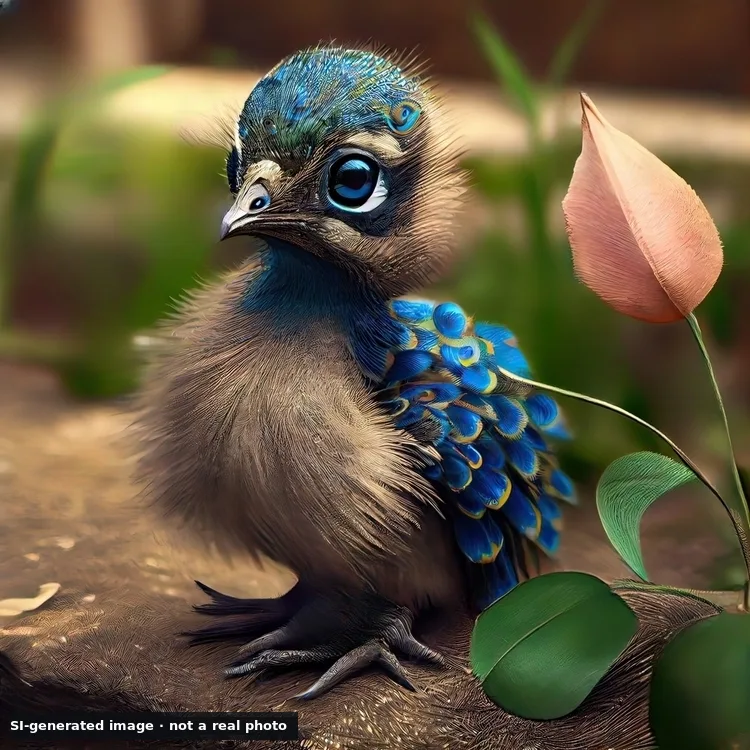
Result: 99% likely SI. The classifier found the statistical patterns of an SI-generated image in the pixels of this copy.
Metadata: JPEG, 750 by 750 pixels, no camera EXIF data, no Content Credentials, no SI tag in the XMP. Nothing in the file says how it was made.
What the test covers: one copy of one image, as stored on Commons. We did not test screenshots, cropped reposts, the lookalike pictures that fill search results or the 2024 videos.
Two remarks on that result. First, this is close to the easy case for any detector: a polished, uncropped copy of a picture with the smooth, over-finished look of a 2023 generator. A screenshot of a repost, shrunk and recompressed, can score very differently, as our fact-check of the Pope Francis puffer jacket image discusses. Second, the file itself carries no trace of its origin. The label that existed on the stock site was a line of text on a web page. It was never part of the picture, so it vanished at the first download.
The clues you can see yourself
In the copy we tested, a few things stand out once you stop scrolling. We describe this copy only; the lookalikes that came later have their own defects.
- The feet. The toes are a tangle of dark shapes of uneven length, and it is hard to say how many there are or which foot they belong to. Both fact-checkers started there.
- The face. Between the beak and the large eye sits a second, smaller eye-like shape. Birds do not have one.
- The borrowed ornaments. The crown carries a small "eye" marking of the kind found on an adult male's train, and the wing feathers copy the blue and gold of that train. A generator asked for a baby peacock averaged "baby bird" and "peacock".
None of these is proof on its own, and newer generators make fewer mistakes with feet. The strongest argument was never in the pixels. It is that the animal shown does not match the species. Our guide on how to spot SI images lists the visual checks; this case is a reminder to ask the plain factual question first.
Why a harmless fake still matters
Nobody lost money over a blue chick, and no election turned on it. That is the point. Pictures like this one meet no resistance: there is no reason to doubt them, no cost to sharing them, and correcting a friend over a cute bird feels petty. A professor who writes about synthetic media shared it before thinking, and said so in public, which is more than most of us do.
Each share, each repost on a wallpaper site and each copy in a stock library then becomes something a search engine can find. The picture that started as a labelled stock image ended up as the top answer to a factual question, without its label. The same route is open to pictures of medicinal plants, edible mushrooms or historical events, where a wrong answer costs more.
How to check a too-cute animal picture
- Ask what the animal should look like. Search the species name with the proper word for its young ("peachick", not "baby peacock") and prefer zoos, botanical gardens, museums and bird guides.
- Do not trust the first image result. Open the page behind the picture. A stock library, a prompt gallery or a wallpaper site is not a source on wildlife.
- Check who posted it. A page named after a famous magazine is not that magazine. Read the account details before you share.
- Run a reverse image search. In this case it led straight to the stock listing.
- Use a detector as one signal among several. You can upload a picture or paste its address into SI or Not. A high score on a clean copy is useful; a low score on a blurry screenshot proves nothing.
If you want to train your eye on pictures where the answer is less obvious than a blue chick, our SI or Not game shows real photographs and generated ones side by side.