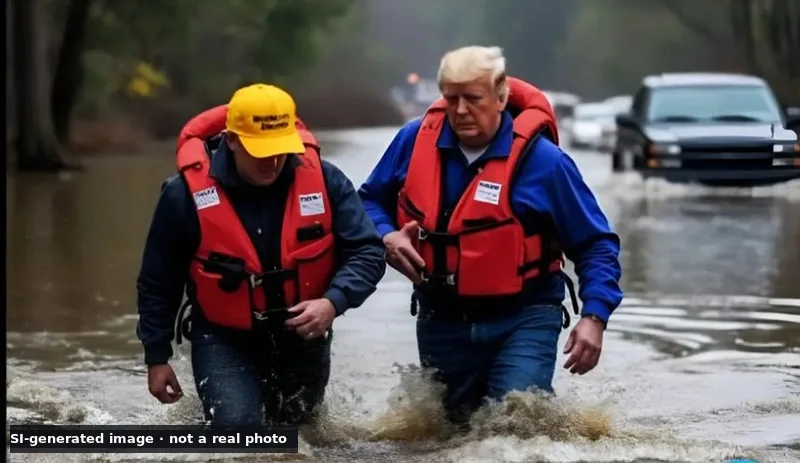
On 30 September 2024, four days after Hurricane Helene came ashore in Florida, a picture began to race across Facebook. It showed Donald Trump, then a former president and the Republican candidate for the White House, in a red life jacket and blue jeans, pushing through brown floodwater next to another man. The caption did not say where or when. It said something more effective: that the platform did not want you to see it.
The scene never took place. The picture was produced by an SI (AI) image generator, and within three days at least four fact-checking teams had said so. Here is what they found, what a public copy of the file returns in our detector today, and why a sentence about censorship did more for this picture than its pixels did.
Claim: a photo shows Donald Trump wading through floodwater to help victims of Hurricane Helene.
Verdict: false. The image is SI-generated. Snopes and Lead Stories called it fake on 1 October 2024, PolitiFact said it was fabricated on 2 October, and USA Today rated it "Altered". Trump did visit Georgia on 30 September, in a suit and on dry ground.
What the picture shows
We describe the copy we tested, a landscape image of 934 by 540 pixels. Two men walk towards the camera through water that reaches the middle of their thighs. The man on the left wears a dark jacket, a red life jacket and a yellow cap whose brim hides his eyes. The man on the right has Trump's face and hair, a bright blue shirt, a red life jacket and jeans. Behind them, a dark pickup truck stands in the flooded road and trees fade into grey mist. Water splashes around their legs.
Nothing in the frame says where this is. There is no street sign, no landmark, no readable badge. Fact-checkers described the life jackets as orange or reddish orange; in this copy they look red.
What really happened on 30 September 2024
Helene made landfall on the Florida Panhandle on 26 September 2024 as a Category 4 hurricane, according to AFP, and then moved inland across the Southeast. The death toll rose for days. Snopes wrote of nearly 140 known deaths on 1 October, USA Today of at least 180 in its fact-check, and AFP counted 212 from official figures on 3 October, across North and South Carolina, Georgia, Florida, Tennessee and Virginia. These are the same disaster counted on different days.
On 30 September, Trump travelled to Valdosta, Georgia, a town damaged by the storm. That visit is thoroughly documented. PolitiFact lists photographs and video from eight news organisations, all showing him in a dark suit, a red tie and a red campaign cap. PolitiFact calls the suit navy blue and USA Today black; neither is a blue shirt, jeans and a life jacket.
So the fake did not invent a trip. It attached an invented scene to a real one, on the very day it happened. A commenter quoted by Snopes wrote under the post: "It did happen in Valdosta, Georgia, today!" Half of that sentence was true, which made the other half easy to accept.
A caption built for sharing
The post that carried the picture furthest was published on Facebook on 30 September. USA Today quotes its caption as: "I don't think FB wants this picture on FB. They have been deleting it." We do not name the account, which belongs to a private person.
Snopes counted more than 150,000 shares in 16 hours. USA Today counted more than 160,000 in two days and found the image on Instagram as well. PolitiFact checked a copy posted on Threads the same day.
The caption deserves a closer look than the image. It makes no factual claim about Trump at all. It only says that someone powerful is hiding the picture, and leaves the reader to conclude that it must therefore be real and important. Sharing becomes an act of resistance. Snopes compared it to older rumours about Facebook supposedly removing Bible verses or posts about Santa Claus, and called the deletion story an accusation without evidence.
The record points the other way. When the technology site Futurism wrote about the picture on 4 October, the post was still online. It carried an "altered photo" warning and a link to an independent fact-check. PolitiFact, a partner in Meta's fact-checking programme, likewise wrote that posts sharing the image were flagged.
How the fact-checkers settled it
Four teams worked on the picture in three days.
| Who | When | Main evidence |
|---|---|---|
| Snopes | 1 October 2024 | No news report of the scene; a broken-looking thumb on Trump's right hand |
| Lead Stories | 1 October 2024 | A detection tool; a reverse image search with no reliable result; the clothes worn in Valdosta |
| PolitiFact | 2 October 2024 | Photos and video from eight outlets showing a suit and tie; a malformed right hand |
| USA Today | 3 October 2024 | Two university experts; four-fingered hands; illegible lettering; a detection tool |
The strongest argument is the simplest one, and all four used it. A presidential candidate does not walk into a flood unobserved a few weeks before an election. PolitiFact found it unbelievable that this would be the only such picture to exist, given the constant media attention around the campaign. A reader quoted by Snopes asked: "Where is the Secret Service?"
USA Today added two specialists. Walter Scheirer, an engineering professor at the University of Notre Dame, called the image likely "the product of a generative AI algorithm" and pointed to something anyone can check: "One key giveaway is that the clothing of the two men appears to be dry." People who wade through water get soaked, he said, as real photographs from the hurricane show.
James O'Brien, a computer science professor at the University of California, Berkeley, looked at the face. He noted that a life jacket strap seems to run over the right side of it and that the face looks smudged, and he offered a hypothesis: "I believe that Trump's face was added to another image and that the software that added the image made an error when it was blending the edges." That is one expert's reading. No source we read identifies the tool or the person behind the picture. Snopes wrote that it was unclear who created it, and the Wikimedia Commons page for the file lists the author as unknown.
Two of the four also ran the picture through commercial detection tools. Lead Stories reported 99 percent confidence that it was generated, and USA Today reported 99.9% from a different tool.
What our SI detector says about a public copy
A copy of the picture is stored on Wikimedia Commons under the file name "AI-generated Donald Trump wading through floodwaters.jpg". It was uploaded there on 10 October 2024 and is tagged as public domain because it was produced by software. The Commons page gives the Facebook post of 30 September and the Futurism article as its sources. On 10 October 2026, two years to the day after that upload, we ran the file once through our SI image detector.
Result: 99% likely SI. The classifier found the statistical patterns of an SI-generated image in the pixels of this copy.
Metadata: JPEG, 934 by 540 pixels, about 72 KB, no camera EXIF data, no Content Credentials, no SI tag in the XMP. Nothing in the file says how it was made.
What the test covers: one copy of one image, as stored on Commons. We did not test screenshots of the Facebook post, cropped versions or the other storm pictures mentioned below.
A detector agreeing with four fact-checkers is no surprise. The file is small and compressed, yet it is still a direct copy of the picture. A screenshot of a phone showing the same post could score differently. And the file is silent about its own history: no camera data, no provenance record, no label. Whoever made it left nothing behind, which is why its authorship is still an open question two years later.
The clues you can see in this copy
This is what is visible in the file we tested; cropped or recompressed reposts may hide some of it.
- The right hand. The hand held in front of the life jacket is where most fact-checkers stopped. The thumb is oversized and oddly angled, and the fingers melt into the belt.
- The lettering. The patches on both life jackets and the mark on the yellow cap imitate printed text without forming a single readable letter.
- The dry clothes. Shirts, sleeves and jackets show no dark, soaked areas above the waterline, despite the splashing.
None of these is proof on its own, and current generators make fewer of these mistakes. Our guide on how to spot SI images explains why visual checks are a starting point and not a verdict.
One fake among many after the storm
The Trump picture was not an isolated case. AFP examined an image shared on X on 29 September with the words "Gatlinburg, Tennessee today", showing a mountain town under water. The city answered on its official account: "This is an AI photo and not real." AFP noted that the logo of Meta's image generator was visible in a corner of that picture, and that the town had been largely spared. Futurism described other generated storm scenes that week, from flooded houses to dogs stranded on roofs.
It was not new for Trump either. Snopes recalled that after Hurricane Harvey in 2017, pictures had circulated claiming to show him rescuing two cats and a stranded person. The genre is older than image generators; what changed is how little time an entry takes to make.
We met the same pattern in our fact-check of the Hollywood sign fire images, which spread while real fires were still burning. A disaster creates an urgent demand for pictures, and a generated one arrives on time and shows what people hope or fear to see.
Why it worked
Three things combined: a real visit on the same day, a caption that turned doubt into a reason to share, and an image that flattered a belief its audience already held. One Facebook user quoted by Snopes wrote: "He lives and cares for people, all people!"
The most useful voice in the whole episode came from the same audience. Snopes quotes a commenter who wrote: "As a Trump supporter, it's okay to recognize that this photo is AI-generated. Yes, he is helping with relief efforts in Georgia. No, this photo is not real." Whether a politician cares about flood victims is an opinion. Whether he stood in that water is a fact, and a fabricated picture adds nothing to either side. The same confusion ran through the generated pictures of Trump's arrest a year and a half earlier, shared by people who wanted the scene to be true and by people who dreaded it.
How to check a disaster picture of a public figure
- Look for the event, not the image. A candidate's visit to a disaster zone is covered by agencies and television. Search the date and the place, and compare clothes, weather and setting.
- Treat "they are deleting this" as a warning sign. A claim of censorship is not evidence that a picture is real. Posts that are flagged usually stay visible with a notice attached.
- Zoom in on hands and text. Count fingers, read badges and caps. Check whether wet things look wet.
- Run a reverse image search. If the only results are social media reposts and no news outlet, be careful. Our guide to reverse image search shows how.
- Use a detector as one signal among several. You can upload a picture or paste its address into our SI scanner. A high score on a clean copy is useful; a low score on a blurry screenshot proves nothing.