On 8 January 2025, while real wildfires were destroying whole neighbourhoods of Los Angeles, a second fire started online. Pictures and short clips showed the nine white letters of the Hollywood sign glowing above a burning hillside, with captions announcing that the city's most famous landmark was gone. The letters were never touched. The pictures were made with SI (AI) image generators and editing software, and at least two of them still carried the logo of the tool that produced them.
There was never a single "Hollywood sign on fire" picture. There was a small crowd of them, made by different people with different tools, all telling the same false story at the same moment.
Claim: photos and videos show the Hollywood sign on fire during the Los Angeles wildfires of January 2025.
Verdict: false. The sign was never burned or damaged. Reuters, AFP, Snopes, Full Fact, PolitiFact, AAP FactCheck and Lead Stories all found the visuals to be fabricated, several of them with SI tools, and the Hollywood Sign Trust, which maintains the landmark, said it was "not affected" and "secure".
The sign that did not burn
The rumour had a real fire behind it, which is why it travelled so well. The Los Angeles wildfires began on 7 January 2025. According to Reuters, the fires spread to the Hollywood Hills on 8 January and the Los Angeles Fire Department issued an evacuation order. That blaze, named the Sunset Fire, was centred just above Hollywood Boulevard and the Walk of Fame.
It never came close to the letters. Reuters wrote that it would have needed to spread at least two miles and cross the 101 Freeway to reach the sign. Snopes, citing Cal Fire and the fire department, put the distance at around three miles on the morning of 9 January, and AAP FactCheck measured about 3.7 km on Google Maps. The estimates differ, but all of them put miles of city between the flames and the landmark. By Thursday 9 January, firefighters had reduced the Sunset Fire to about 43 acres, the evacuation order was lifted, and no buildings had been lost in that area, Reuters reported.
Three kinds of evidence showed the sign was intact:
- The people responsible for it. Jeff Zarrinnam, chair of the Hollywood Sign Trust, told Reuters, AFP and Lead Stories by email on 9 January that Griffith Park had been closed as a precaution but that the sign itself was "not affected and is secure". The Trust also posted that the sign "continues to stand tall" and called the burning image fake.
- Photographers on the ground. A Reuters photographer pictured the sign intact on 9 January with no fire nearby. AFP published its own photo taken the same day from the corner of Gower Street and Temple Hill Drive, and PolitiFact pointed to Associated Press photos from 9 January showing the letters untouched.
- The fire maps. AAP FactCheck checked the California Department of Forestry and Fire Protection map and found that the sign's location was not inside any fire area.
Not one fake, but a dozen
Hany Farid, a professor at the University of California, Berkeley, and co-founder of the detection company GetReal Labs, told NPR that he saw "maybe a dozen images and videos of the Hollywood sign on fire", and that the first fakes of the Los Angeles fires appeared "within 24 hours".
The fact-checkers did not all examine the same file, so it helps to sort what they found. AFP alone described five different visuals. Put together with the other reports, the fakes fall into four families.
| What circulated | What gave it away | Who documented it |
|---|---|---|
| Still images of the letters in flames, with a small logo in the bottom-right corner | The logo is the watermark of Grok, the SI chatbot built into X. Copies on other platforms had lost it. | Snopes, Full Fact, Reuters, AFP, AAP |
| A still image where the sign reads "Hollywoodd" | An extra letter D at the end of the word, plus the same Grok watermark | AFP, AAP |
| Other still images, including one with no watermark | Brackets and lattices behind the letters that do not match real photos; lighting and compression that differ between the flames and the background | PolitiFact, AFP, Reuters |
| Short videos of flames around the sign | One was traced to a TikTok account that describes itself as making graphics and video scenes; in another, the towers that stand behind the real sign are missing | Snopes, AFP, AAP, Lead Stories |
We reproduce only one of them, the copy we tested further down, with a label added on the picture itself. The fact-checks listed under this article show them next to their analysis.
How the fakes were taken apart
A watermark nobody had removed
The simplest clue was printed on the picture. Snopes noted on 9 January that the best-known image carried a Grok watermark in its bottom-right corner. Full Fact found a Grok mark on an uncropped version of the image it checked, posted on X, and observed that it was absent from the copies circulating on other social platforms. AFP reported that the user who appears to have been the first to post one watermarked image made clear in follow-up posts that it had been created with SI. That author, at least, was not hiding anything. The label was lost as the picture moved from one platform to the next.
James O'Brien, a professor of computer science at Berkeley, told Reuters that images with the Grok watermark are "essentially labeled as being from a Generative AI". A visible mark is fragile, though: trimming a corner removes it. Signed metadata such as Content Credentials is sturdier, but it too is often lost when a file is re-encoded or shared as a screenshot.
Making the same picture again
Two newsrooms went one step further and reproduced the fake. Full Fact gave Grok the prompt "show me the Hollywood sign on fire" and received several images similar to the viral one. Reuters did the same and obtained pictures of the burning landmark that resembled the fakes. This does not prove where a particular file came from, but it shows how little effort the hoax required: one sentence.
Counting the brackets
For the other images, the experts looked at structure. Siwei Lyu, who directs the Media Forensic Lab at the University at Buffalo, told PolitiFact that the number of lattices supporting the letter H in one viral image did not match a stock photo of the sign. He told AFP that the brackets behind the letters in another were misaligned and misshapen, and that the towers behind the sign were missing from one of the videos. Farid, in a statement quoted by AFP, pointed to "obvious structural inconsistencies with the iconic Hollywood sign, including differences in letter shape and surrounding structures".
O'Brien added a different kind of clue for Reuters. In an image without the Grok mark, the lighting on the letters looked unnatural and the fire, the lighting and the background showed different levels of compression, a sign that flames had been added to an existing photo with editing software or a generator.
When the detector shrugs
Lead Stories ran the video and two of the images through a public detection tool, TrueMedia.org, and received the answer "Uncertain" all three times. Its fact-checkers reached their verdict the old way: an email from the Trust and reverse image searches that turned up no credible original. Lyu, for his part, told AFP that his own detection algorithms found the visuals were likely made with text-to-image programs. Two tools, two different answers on the same family of pictures. We explain why that happens in our article on detector accuracy.
What our SI detector says about a public copy
We ran one test of our own. Wikimedia Commons hosts a copy of one of the viral images, described there as an SI-generated hoax picture from the 2025 California wildfires and sourced to an X post of 9 January 2025. The file is a 985 x 738 pixel JPEG of 68 KB. In this copy the word is spelled correctly and no Grok watermark is visible, so we cannot say which generator made it. Commons lists the author as unknown. We uploaded that one file to our SI image detector on 7 October 2026.
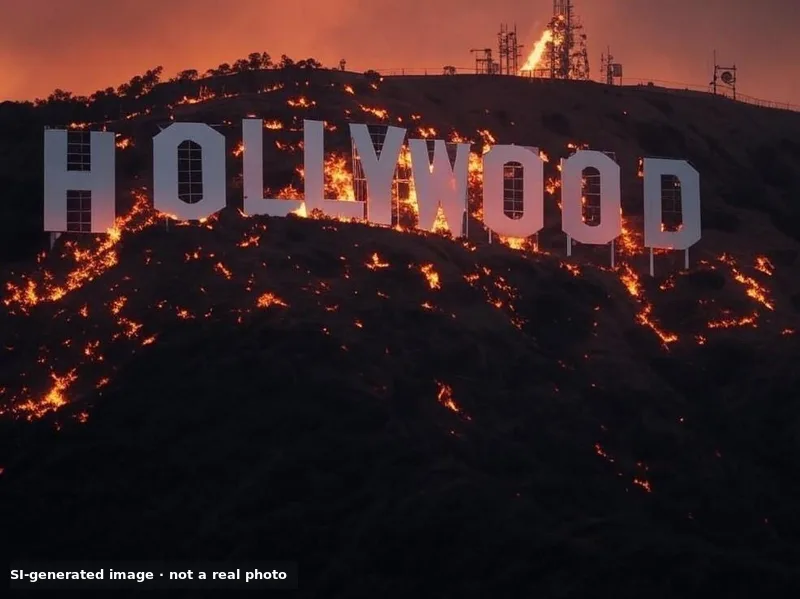
Result: 99% likely SI. The classifier found the statistical patterns of an SI-generated image in the pixels of this copy.
Metadata: no camera EXIF data, no Content Credentials, no SI tag in the XMP. Nothing in the file says where it was made, which is normal for an image that has been downloaded and uploaded again.
What the test covers: one copy of one image. We did not test the watermarked version, the misspelled one or the video.
The site had returned the same verdict for the fake Pentagon explosion photo and the Pope Francis puffer jacket image. Three images are far too few to draw a rule from, and any detector can be confidently wrong, including ours. A score from any SI detection tool is a clue to weigh with the rest, never a verdict on its own.
Why a burning sign was so easy to believe
The person best placed to judge the fakes admitted they were good. Zarrinnam told NPR that a colleague phoned him at work to say the sign was on fire. He can see it from his office and from his home, so he looked. It was still there. But he did spot a real wildfire in Runyon Canyon and rushed home to help his family evacuate, while people kept texting him pictures of the sign in flames. "They look so real that I couldn't tell if it was real or not," he said. Had he not seen the sign himself, he added, he would probably have believed it.
Several things worked in the hoax's favour:
- A true story next door. There really was a fire in the Hollywood Hills, with evacuation orders and helicopters dropping water. The fake only moved it a couple of miles.
- Dusk, smoke and glow. The copy we tested is a dark scene lit by embers under an orange sky. There is little fine detail to inspect, and the letters, the one thing everyone knows, are spelled correctly.
- The live proof went dark. The sign has public webcams, but Zarrinnam told NPR that the flood of interest overwhelmed them, and Hollywoodsign.org told Snopes by email that the cameras would "slowly but surely come back up".
- A ready-made moral. Reuters quoted a Facebook caption calling the fire "a sign from God". A picture that confirms what someone already feels gets shared before it gets checked.
Speed did the rest. Snopes found that one early post of the video had passed 100,000 views before it was taken down.
The cost of a "harmless" fake
Nobody was defamed by these pictures. That does not make them harmless. Zarrinnam told NPR that the Trust was "inundated with emails from news agencies around the world" asking whether the sign was safe, at the very moment he was getting his family out.
Farid told NPR that such false alarms distract fire services and sow confusion. He also described a slower kind of damage: "It's not just that you're perpetrating a fraud. It's that you're creating and sowing doubt in all content." Every convincing fake makes the next real photo of a disaster a little easier to dismiss.
How to check a landmark "in flames"
Before sharing a picture of a monument burning, flooding or collapsing:
- Look for a live view. Many landmarks have official webcams or traffic cameras. If they are down, as they were here, move to the next step.
- Open the official incident map. Fire and civil protection agencies publish perimeters. A landmark miles outside every perimeter is not burning.
- Search the news agencies. Reuters, AFP and AP had photographers in Los Angeles. Had the sign caught fire, their pictures would have shown it.
- Inspect the corners and the spelling. Look for a generator's logo, and read the text in the image letter by letter. Then compare the structure with a real photo.
- Find the uncropped original. A reverse image search can surface an earlier version that still shows a watermark, or a first post where the author says it is generated.
- Use a detector last, and read it as one opinion. Our guide to spotting SI images explains how to combine a score with the visual and contextual clues.
What this case shows
The burning Hollywood sign was debunked within two days by seven fact-checking teams, and still spread widely. At least one of the people who made these pictures said openly that the image was generated. The label fell away and the picture kept its power. The decisive evidence did not come from software but from a man looking out of his window, photographers standing in the street and a public fire map.
Zarrinnam compared the sign to the Eiffel Tower in Paris, a symbol that a city's image depends on. The next disaster will bring the next landmark. The checks above take a few minutes.