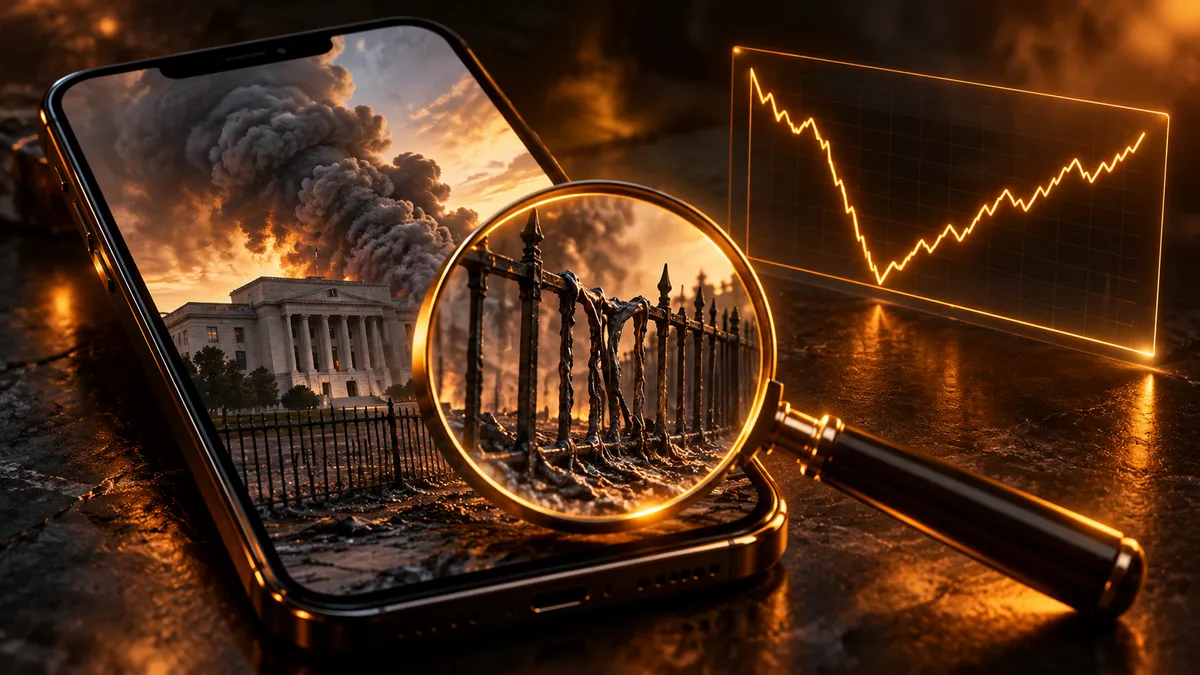
On the morning of 22 May 2023, a picture of a huge black plume of smoke rising next to a pale government building spread across Twitter with the caption "explosion near the Pentagon". Within minutes it was reposted by accounts with blue check marks, picked up by a Russian state broadcaster and aired by several television channels in India. Wall Street wobbled. There had been no explosion. The picture was a fake, and fact-checkers quickly pointed to the tell-tale marks of an SI (AI) image generator.
This was not the first viral SI image, but it was one of the first to cause measurable harm in the real world within an hour. It remains a textbook case for anyone who wants to check a breaking-news photo before sharing it. Here is what the image showed, how it spread, what the official sources said, what the visual clues were and what our own detector makes of a copy of it today.
Claim: a photo shows an explosion outside the Pentagon on 22 May 2023.
Verdict: false. The US Defense Department told AFP the Pentagon was not attacked, the Arlington County fire department said there was no incident, and fact-checkers found the picture shows a building that does not exist, with defects typical of SI generation. Its original creator has never been identified.
What the image showed
The picture is a wide street-level view. On the left, a tall column of dark grey and black smoke billows out of the trees, with a hint of orange near its base. On the right stands a long, light-coloured office block with a columned entrance. In the foreground runs a row of metal crowd barriers and a black fence, a lamp post, a strip of grass and an empty road.
At a glance, on a phone screen, it looks like news photography: natural daylight, a believable angle, nothing obviously cartoonish. That is exactly why it worked. The problems only appear when you look at the details, or when you compare the scene with the real Pentagon.
How the fake spread, minute by minute
NBC News reconstructed the timeline from the posts themselves. The earliest copy it found was shared at 8:42 a.m. Eastern Time by a paid-verified account, @CBKNews121, which displayed QAnon iconography and later deleted the post. AFP also identified a QAnon-promoting account called "CBKNEWS" as the earliest sharer it could find, while noting that the original source of the image was not known. Forbes reported that the picture took off on fringe pages "just after 10 a.m.", which matches the rest of the timeline.
| Time (ET, 22 May 2023) | What happened | Reported by |
|---|---|---|
| 8:42 a.m. | Earliest known post of the image, by a paid-verified account with QAnon imagery | NBC News |
| 10:03 a.m. | RT, the Russian state broadcaster, tweets about "reports of an explosion near the Pentagon" | NBC News |
| 10:06 a.m. | A business news influencer with more than 650,000 followers posts about a "Large Explosion near The Pentagon Complex", later deleted | NBC News |
| Minutes later | Zero Hedge shares the image with its 1.6 million followers; a fake verified account called @BloombergFeed, unrelated to Bloomberg, pushes the claim and is later suspended | NBC News, AFP |
| Around 10:27 a.m. | The Arlington County fire department says there is no explosion or incident at or near the Pentagon | NBC News, AFP |
| Same day | The Defense Department confirms the report is false; the S&P 500 dips briefly, then recovers | AFP, Forbes, The Guardian |
Other accounts with large audiences joined in. The Guardian notes that OSINTdefender, a page sharing military news with more than 336,000 followers at the time, posted the photo and later apologised, saying the episode showed how easily such images can be used to manipulate the information space. In India, The Quint's fact-checking team Webqoof found that several channels, including Times Now Navbharat, Zee News, News18 Madhya Pradesh and First India News, shared the claim; Republic TV aired it and later issued a correction.
What the official sources said
The denial came fast and from the right people. A Defense Department spokesperson told AFP: "We can confirm this was a false report and the Pentagon was not attacked today." The fire department for Arlington County, the Virginia county where the Pentagon stands, posted that there was "no explosion or incident taking place at or near the Pentagon reservation", and Forbes quoted the same department saying there was no "immediate danger or hazards to the public".
AFP added a piece of first-hand evidence that no image analysis can replace: a journalist who was at the Pentagon that morning saw no smoke and no emergency response after the rumour went viral. When a claim concerns a public place, a reporter or a live camera on the spot settles the question faster than any detector.
The visual clues fact-checkers spotted
The fakery is visible once you know where to look. The fact-checks converge on four kinds of evidence.
- The building is not the Pentagon. The real headquarters is a massive five-sided building. AFP found that the structure in the image does not resemble it, NBC described it as "a rectangular building with only a passing resemblance to the Pentagon", and Webqoof compared entrances, corners and fences and found no similarity.
- The place does not exist. Nick Waters, an investigator at Bellingcat, told NBC News that when you try to geolocate the picture "you can't because it's not a real place". Reverse image search and map comparison are often the fastest route to that kind of conclusion.
- Objects melt into each other. Waters noted that the fences in front of the building "morph and meld into one another". AFP pointed out that the sidewalk seems to blend into the street, the grass and the fence in places.
- Structures are inconsistent. AFP observed that the columns on the building have mismatched sizes and that the lamp post in the foreground appears disjointed. Webqoof flagged the same fence, barriers and street lamp.
These are classic weaknesses of image generators in 2023: they render textures convincingly but struggle with the logic of repeated structures such as railings, columns and windows, and they invent places rather than reproduce real ones. Waters summed it up: SI image tools were "still really not great at producing accurate locations". Our guide on how to spot SI images explains how to look for this kind of defect step by step. Generators have improved a lot since then, so the absence of such defects in a newer picture proves much less.
A copycat followed. The same day, another image claimed to show an explosion at the White House. According to AFP, the building did not resemble the White House and no smoke was visible on a live webcam of the residence. Waters told NBC it spread less, partly because it "didn't look anything like the White House".
Why such a crude fake worked
None of the fact-checkers argue that the picture was a masterpiece. It travelled because of the context around it.
Paid check marks looked like credibility
A month earlier, Twitter had changed what its blue badge meant. As NBC and The Guardian explain, the check mark used to signal an identity verified by the platform; under the new Twitter Blue programme it could be bought for $8 a month. Several accounts that pushed the image looked like news organisations or intelligence feeds, including one borrowing Bloomberg's name. Readers who trusted the badge were trusting a payment, not a verification.
Breaking news rewards speed
Aggregator accounts compete to post first. A dramatic image with a short caption in capital letters, "EXPLOSION NEAR THE PENTAGON", needs no context to be shared. By the time the fire department replied, the claim had already jumped to other platforms and to television.
Automated readers reacted too
AFP reports that the S&P 500 slipped by 0.29 percent before recovering, and NBC describes a sharp drop in the minutes after the image was amplified by well-followed accounts. A brief dip does not prove that the picture alone moved the market, but the timing was close enough for every outlet covering the story to note it. It showed that a single fabricated image could reach investors within the hour.
What our SI detector says about a copy
The original file has never been traced, so the only copies available today are reposts and screenshots. We downloaded the version AFP published in its fact-check, a 645 x 639 pixel JPEG on which AFP had added a magnifying circle over the lamp post, trimmed its thin border and ran it through our SI image detector on 5 October 2026. We do not reproduce the image here; AFP's article shows it with annotations.
Result: 99% likely SI. The verdict came from the second, independent classifier we run on every image, which rated the copy 99% SI-generated.
Our own pixel classifier got it wrong. On its own, it rated the same copy at 0.2% SI, in other words "strongly towards a real photo". The other clues were weak: no camera EXIF data (normal for a reposted image) and a low resolution of 620 x 615 pixels after trimming, which on its own would have kept the result at "uncertain" rather than "likely real".
Metadata: no Content Credentials, no SI tag, nothing. Every trace of the original file was lost long before this copy was made.
We report the miss because it matters. A three-year-old fake, recompressed several times and annotated by a fact-checker, is a hard case for any pixel classifier, and our main model read it as a real photograph. The final verdict was right only because two classifiers looked at it. That is the honest lesson of this test: a single score, from us or anyone else, is a clue, not a verdict. Our article on whether SI detectors are accurate explains why both false negatives and false positives happen.
In this story, the decisive evidence was never a detector. It was a denial from the Defense Department, a statement from the local fire department and a reporter standing in front of an intact building.
How to check a breaking-news image yourself
The Pentagon fake took less than two hours to go from the first known post to an official denial. You can usually move faster than that with a few habits.
- Look for the official source. For an incident in a public place, emergency services, the local police or the institution concerned usually post within the hour. No statement after a supposed explosion at a major landmark is itself a warning sign.
- Compare with the real place. Open a map or a reference photo of the location. If the building does not match, you are done.
- Run a reverse image search. It can find an earlier copy, an existing fact-check or the account that first posted the picture. Our guide on how to reverse image search covers Google Lens, Bing and TinEye.
- Zoom in on repeated structures. Fences, railings, windows, columns, text on signs and lamp posts are where generators still slip.
- Check the account, not the badge. How old is it, what does it usually post, does it link to a real newsroom? A paid check mark tells you nothing about any of this.
- Use a detector as one clue among others. If you still wonder "is this SI?", upload the best copy you can find. Original files are far more informative than screenshots, because they may still carry Content Credentials or other metadata.
What this case does and does not show
The Pentagon image is often described as a "deepfake". In the broad sense, a synthetic piece of media made to deceive, the label fits; our explainer on what a deepfake is covers the different meanings. But no source we read identified the tool used to make it, and no one has claimed authorship. Statements that it was made with one specific generator are guesses.
It also does not show that SI images are unstoppable. The fake was debunked within the hour by ordinary verification: official statements, a reporter on the ground and attention to detail. What it shows is that, in the first minutes, distribution matters more than quality. A crude image pushed by accounts that look official can travel further than a perfect one posted by nobody.
If you want to train your eye on the same kind of clues, our SI or Not game mixes real photographs with SI-generated ones and tells you after each answer whether you were right.