In the spring of 2023, a black-and-white portrait of two women won a category of a prestigious international photography competition. At the ceremony in London that April, its author went on stage and turned the prize down, because no camera had been involved. The picture, The Electrician by the German artist Boris Eldagsen, was produced with an SI (AI) image generator. This fact-check goes through what happened, who knew what and when, what the image looks like up close, and what our own detector says about a public copy of it.
It is a different kind of case from the ones we usually cover. Nobody forged a news event here: the person who made the image is the one who revealed it, to start an argument. That makes it a useful test of a simple question: can experienced eyes tell?
Short answer: the image is SI-generated, by its author's own account. Boris Eldagsen says he made it with DALL-E 2 in 2022, entered it in the Sony World Photography Awards without saying how it was made, won the Creative category of the Open competition, and refused the award at the ceremony on 13 April 2023. The organisers say they knew SI was involved before announcing him as a winner. Our detector rates a public copy 99% likely SI.
What the image shows
The full title is Pseudomnesia: The Electrician. It is a vertical portrait in the style of an old studio photograph. A young woman in a pale wrap dress looks past the viewer. Behind her, an older woman leans in close and rests a hand on her shoulder. The surface looks aged: pale scratches run down from the top, and one edge carries a yellow stain, as on a damaged negative.
The Guardian's Zoe Williams read it as a possible wedding day and called it "an immensely evocative scene". The press release announcing the win, as quoted by Scientific American, described the picture as "haunting" and "reminiscent of the visual language of 1940s family portraits". Artforum attributes that description to Eldagsen's own submission text.
The series title was a hint. On his website, Eldagsen explains that pseudomnesia means a pseudo memory, "a spurious recollection of events that never took place". He describes the series as "fake memories of a past, that never existed, that no-one photographed". By that description, the two women never sat for anyone.
How the image was made
Eldagsen told Scientific American that he used DALL-E 2, and that the picture "was all done by text prompts and inpainting and outpainting". Inpainting means erasing one part of an image and asking the generator to redraw it. Outpainting means extending the frame so the generator invents what lies beyond the original edges. His website says the images in the series were "re-edited more between 20 to 40 times" through SI image generators.
He has always insisted that this is work, not a button press. "The process has many steps, it's not putting in three words and clicking 'generate'," he told the Guardian. In the statement he published when his selection was announced, he called the method "a co-creation, in which I am the director".
The idea came from family history. He told Scientific American that after his father's death he found photographs from the 1940s that he and his mother had never seen, and that his first experiment with a generator was to ask whether he could recreate images of that time. He dates The Electrician to early September 2022. In November 2022, according to his website, he and the gallery Photo Edition Berlin released it as a limited edition of 10 prints.
From entry to refusal: the timeline
Most of the dates below come from the chronology Eldagsen published on his own website on 18 April 2023, built from his email exchanges with the organisers. The World Photography Organisation, which runs the awards, has not published a competing timeline, but its statements to the BBC, the Guardian and CBS News confirm the key step: he disclosed the use of SI after being selected and before the public announcement.
| Date | What happened | Source |
|---|---|---|
| Early September 2022 | The image is made with DALL-E 2. | Eldagsen, to Scientific American |
| December 2022 | He enters the Open competition with no information about how the picture was produced. | Eldagsen's chronology |
| 2 March 2023 | He is told he has won the category. | Eldagsen's chronology, CBS News |
| 3 March 2023 | He writes to the organisers explaining that his work now explores SI generators, and suggests a public discussion. | Eldagsen's chronology; confirmed in substance by the organisers |
| 14 March 2023 | The category winners are announced. He publishes a statement calling his images "synthetically produced". | Eldagsen's website, Artforum |
| 13 April 2023 | At the ceremony in London, he refuses the award. | Eldagsen's website, BBC |
| 14 April 2023 | He reports that his name and image are gone from the awards website and from the exhibition at Somerset House. | Eldagsen's website |
Reports differ on when the image "won": Scientific American says March, the BBC says the week of the ceremony. Both fit the chronology, since the category winners were named on 14 March and the ceremony took place on 13 April.
What he said on stage
The refusal statement is on Eldagsen's website and was quoted by every outlet that covered the story. "Thank you for selecting my image and making this a historic moment, as it is the first AI generated image to win in a prestigious international PHOTOGRAPHY competition," it begins. It continues: "AI images and photography should not compete with each other in an award like this. They are different entities. AI is not photography. Therefore I will not accept the award."
He also explained the motive in a phrase that travelled around the world: "I applied as a cheeky monkey, to find out, if the competitions are prepared for AI images to enter. They are not." He asked that the prize be donated to a photo festival in Odesa, Ukraine.
The claim to be "the first" is his own. We found no independent survey that confirms or contradicts it.
Who knew what, and when
This is the part of the story where the two sides still disagree, and it is worth being exact.
A spokesperson for the World Photography Organisation told CBS News, the BBC and the Guardian that before Eldagsen was announced as the winner, he "confirmed the 'co-creation' of this image using AI". The organisers added that the Creative category "welcomes various experimental approaches to image making from cyanotypes and rayographs to cutting-edge digital practices", and that they had felt his entry "fulfilled the criteria for this category". After the refusal, they said his statement showed "deliberate attempts at misleading us" and that they could no longer "engage in a meaningful and constructive dialogue with him". The Guardian later amended its interview to add the organisers' position that the judges "were always aware" the image used elements of SI.
Eldagsen's version is that he supplied no information about the method when he entered, because the rules allowed "any device", and that he explained it by email on 3 March, the day after being told he had won. He says he offered a public discussion three times, was promised a question-and-answer piece for the awards blog, and waited 22 days for questions that never came.
Put together, the two accounts overlap more than the tone suggests. Both say the disclosure came after the selection and before the public announcement. What neither side's published statements establish is what the judges believed at the moment they chose the picture. We cannot settle that from the outside.
Could you have told it was SI?
Scientific American put the question to Eldagsen directly. "Of course," he answered, and listed the weak points himself: a difference in colour that comes from outpainting, with the left side "too yellow" while the right side turns black and white, then "maybe the fingers, but also part of the arm on the right side".
Those are visible in the copy we examined. A yellow band runs down the left edge and is absent on the right. The hand resting on the young woman's shoulder on the left of the frame looks swollen and misshapen. On the right, a few fingers lie on her other shoulder and stop at the edge of the picture, and a third hand reaches up from the bottom corner, on an arm that is hard to attribute to either woman.
The rest holds up well: the faces, the fabric, the soft studio light. The scratches and stains help, because damage is what we expect from an old print. Our guide on how to spot SI images covers these checks in order, starting with hands and edges.
Eldagsen added a warning that has aged well. He called The Electrician "very easy to tell" because it was an old image, and predicted that "by the end of this year, we won't be able to tell". He also admitted that he had failed once on an online real-or-generated test run by the German magazine GEO. If you want to measure your own eye, our SI or Not game works the same way.
We ran a public copy through our detector
We downloaded the copy of the image stored on Wikimedia Commons, a 547 by 934 pixel JPEG uploaded on 20 April 2023, and ran it once through our SI image detector on 11 October 2026.
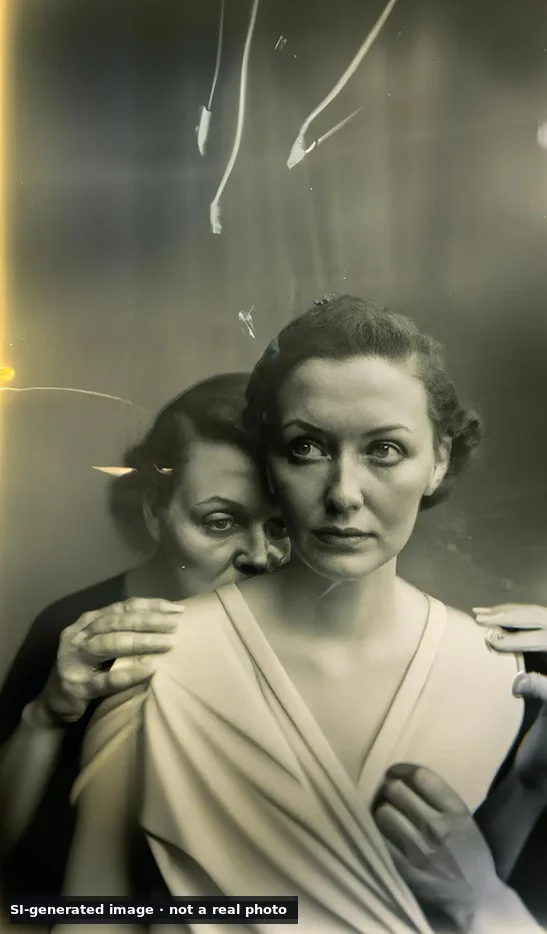
Result: 99% likely SI. The classifier found the statistical patterns of an SI-generated image in the pixels of this copy.
Metadata: JPEG, 547 by 934 pixels, about 69 KB, no camera EXIF data, no Content Credentials, no SI tag in the XMP. Nothing in the file says how it was made.
What the test covers: one copy of one image, as stored on Commons. We did not test the file submitted to the competition, the prints, or photographs of the picture hanging on a wall.
One result on one file proves little about detectors in general. Note what the file does not contain: no signed provenance record and no label of any kind, so the only evidence inside it is the pixels. Our explainer on C2PA and Content Credentials describes what such a record looks like when it exists.
A note on the picture above. Wikimedia Commons tags its copy as public domain on the grounds that it was generated by an algorithm, but Eldagsen sells the work as a limited edition and presents it as his own. We show a small, labelled copy to report on it, with his name on it, and will remove it if he asks.
Why it matters beyond one prize
Eldagsen was not attacking photography. He told the Guardian that he loves both crafts and had realised "they're not the same. One is writing with light, one is writing with prompts." A few days after the ceremony he adopted a word for the second one that, by his account, a Peruvian photographer had suggested on Facebook: promptography.
His real worry lay elsewhere. "The threat," he told the Guardian, "is to democracy and to photojournalism; we have so many fake images, we need to come up with a way to show people what is what." He suggested that news images carry one of three labels: authentic, manipulated or generated. Speaking to Scientific American, he cited the picture of the Pope in a white puffer coat as an image that "should have always been notated". We covered that one in our fact-check of the Pope Francis puffer jacket image.
The story also has a mirror image. In June 2024, the Guardian reported that the photographer Miles Astray had entered a real photograph of a flamingo, Flamingone, in the SI-generated category of the 1839 Awards, where it took third place before the award was withdrawn. Astray said he had been motivated by SI images winning conventional photography contests. Judges, in other words, have been fooled in both directions.
For questions of style and authorship, our piece on SI art and real art goes further. For a picture you have doubts about today, the method is the same as for any viral image: look for the source, look at the details, and run it through an SI checker as one piece of evidence among others.
The bottom line
The Electrician is not a photograph, and its author said so on his own website the day the winners were announced, calling his images "synthetically produced". What the episode exposed was a competition whose rules had not caught up, and a public announcement that left out the one fact people most wanted to know. The image itself carries the usual marks of a 2022 generator once you know where to look, in the hands and along the edges. Eldagsen's own prediction, made that same month, was that such marks would not last.