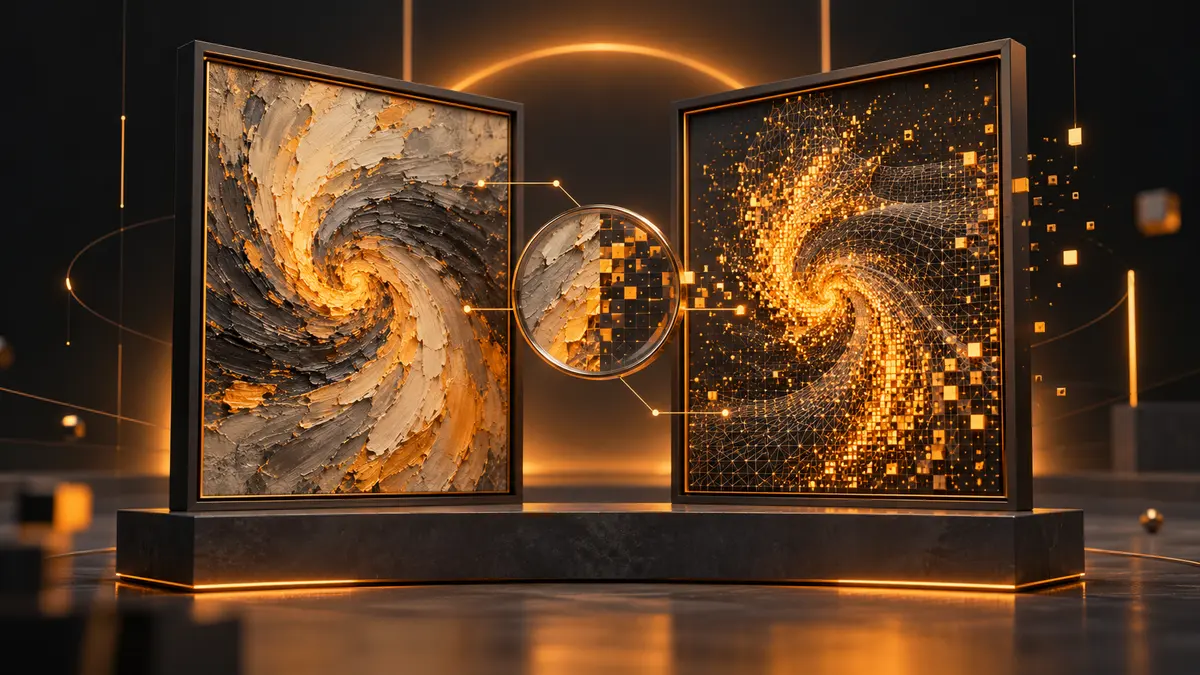
A painting with impossible light, a comic panel with perfect line work, a fantasy landscape shared ten thousand times: was it made by a person or by an SI (AI) image generator? The "SI art vs real art" question looks simple and turns out to be one of the hardest cases in image detection. People guess barely better than a coin toss, detectors trained on photos stumble on drawings, and some of the most famous paintings in history can look "machine-made" to software.
This guide explains why art is harder to check than photos, what research says about humans and detectors, which clues actually help, and what happened when we ran eleven artworks, SI and human, through our own tools. Some results were wrong. We show them anyway.
The short answer
- Your eyes are not enough. In a test with about 11,000 participants, the median score at telling SI art from human art was 60%, only a little above chance.
- Detectors help, but art is a weak spot. Many image classifiers are trained mostly on photos. Illustrations, cartoons and paintings are misread in both directions.
- Provenance beats pixels. A signed Content Credential naming the generator is the strongest clue, when it survives. Sketches, layers and a visible history of an artist's work are the human equivalent.
- Never accuse an artist on a score alone. A detector score is a probability, and bold painted styles are exactly where single classifiers make mistakes.
Why "SI art vs real art" is harder than photos
When you check a photo, you can lean on physics. A camera leaves traces: sensor noise, lens blur, consistent shadows, EXIF data about the shutter and the lens. An SI image that pretends to be a photo has to fake all of that, and detectors learn the places where the fake slips. Our guide on how SI detectors work explains those signals in detail.
Art breaks most of those assumptions. A painting or a digital illustration has no camera behind it, so "no camera data" proves nothing. Artists exaggerate light, smooth skin, simplify backgrounds and repeat patterns on purpose, which are exactly the habits detectors associate with generators. Many works online are themselves reproductions: a scan of a print, a photo of a canvas, a compressed upload of a drawing. And generators were trained on enormous amounts of human art, so they imitate brush strokes, paper texture and famous styles convincingly.
There is a second problem: the training data of detectors. Many image classifiers, including the one we built, were trained mostly on photorealistic pictures. They are good at "is this photo real?" and much weaker at "who drew this?". That is a known limit, and it is why our SI image detector page warns that illustrations, renders and paintings are frequently misclassified.
Can people tell SI art from human art?
The largest informal experiment we know of was run by the writer Scott Alexander on his blog Astral Codex Ten. He asked about 11,000 people to sort fifty pictures into human art and SI images, and published the results in November 2024. "The median score on the test was 60%, only a little above chance."
Two details stand out. Impressionism fooled almost everyone: participants identified every Impressionist painting as human except the only one that really was human, Paul Gauguin's Entrance to the Village of Osny (1882). And a human digital painting, Mitchell Stuart's Victorian Megaship, was judged SI by 84% of respondents. Expertise helped a little: professional artists scored 66% and professional artists who disliked SI art scored 68%. Five people out of 11,000 reached 98%.
A more formal study points the same way. In "Organic or Diffused: Can We Distinguish Human Art from AI-generated Images?", researchers from the University of Chicago built a set of 280 human artworks from 53 artists and 350 SI images from five generators, across seven art styles. They compared automated detectors with three human groups: general users, professional artists and expert artists. General users were the least accurate, expert artists the most accurate and the most confident. Expert artists still made mistakes, often reading clumsy human technique as machine output.
What detectors can and cannot do with art
The same study tested commercial detectors. The best one, Hive, reached 98.03% accuracy on unaltered images and did not flag any of the human artworks in that test as SI. That sounds decisive, but the authors also tried perturbations, the kind of noise and filters images pick up in real life or that artists add on purpose. Glaze, a tool that artists use to protect their style from being copied by generators, pushed the detection rate of Hive and another detector below 70%. Their conclusion is worth quoting: "A combined team of human and automated detectors provides the best combination of accuracy and robustness."
Two lessons follow. First, a detector's result depends heavily on what it was trained on and on what happened to the file before you checked it. Second, a high-quality detector on a clean benchmark is not the same as any detector on a random repost. Our article Are SI detectors accurate? goes through the published error rates and why they vary so much.
Our test: 11 artworks through our own tools
We wanted to see where our own SI scanner lands on art, using only files whose origin and rights we know. On the SI side, we used illustrations we generated ourselves: three dark 3D renders made with ChatGPT for this blog's covers, two cartoon sprite sheets made with ChatGPT for a game prototype, and a sheet of painted gothic props made with an SI image tool for another prototype. We checked the originals, then copies with every piece of metadata removed (re-saved as JPEG), which is what usually happens when an image is reposted. On the human side, we used five public-domain artworks downloaded from Wikimedia Commons: Van Gogh's The Starry Night (1889), Hokusai's The Great Wave off Kanagawa (around 1830 to 1832), Vermeer's Girl with a Pearl Earring (around 1665), Monet's Impression, Sunrise (1872) and one of John Tenniel's illustrations for Alice's Adventures in Wonderland (1865).
With their credentials: 5 out of 5 likely SI. The three ChatGPT 3D renders and the two ChatGPT sprite sheets all came out likely SI (97% to 99.9%). Every file carried a C2PA manifest naming OpenAI plus an IPTC tag "trainedAlgorithmicMedia", which the detector reads first.
Metadata removed, SI art: 5 out of 6 likely SI, 1 uncertain. The three 3D renders and the two cartoon sprite sheets came out at 99% likely SI. The gothic props sheet came out uncertain (35%): the two classifiers disagreed on it and the file is small (458x685), so the site does not call it either way.
Human art: 5 out of 5 likely real. Van Gogh's The Starry Night, Hokusai's Great Wave, Vermeer, Monet and Tenniel all came out likely real.
Total, metadata removed: 10 of 11 correct, 1 uncertain, none wrong. Eleven files is a tiny sample, so read this as an illustration, not as an accuracy figure.

What does this tell us? No single signal is enough on art. Each of the two classifiers behind the site misread some of these files on its own: bold, swirling or strongly graphic styles, like The Starry Night or a woodblock print, sit close to what generators produce, while flat cartoon art with clean lines and solid colours gives a pixel model very little to work with. Combining two independent classifiers, and reading provenance metadata first, is what got the final answers right. The one uncertain result is the honest outcome when the evidence disagrees: we would rather say "uncertain" than guess.
Clues that actually help
Provenance first
The single most useful question is not "how does it look?" but "where does it come from?". Look for:
- Content Credentials. A C2PA manifest signed by a generator is close to a confession. Our guide to C2PA and Content Credentials explains how to read one and why it often disappears on reposts.
- An earlier original. A reverse image search can lead to the first upload, the artist's portfolio, a museum page or a generator gallery.
- A body of work. Human artists usually leave a trail: sketches, work-in-progress posts, older pieces in a consistent style, process videos, layered files.
Then look closely, with care
Visual clues still matter, but they are weaker on art than on photos, because artists stylise on purpose. Things worth zooming in on:
- Text and symbols: signatures that dissolve into scribbles, lettering that almost reads, logos that melt.
- Logic of objects: jewellery that merges into skin, straps that go nowhere, architecture that cannot stand, inconsistent numbers of fingers or limbs.
- Uniform finish: every area rendered with the same polish, including corners a human would usually leave rough.
- Brush strokes that do not follow form: texture painted "on top" rather than building the shape.
None of these clues is proof on its own: tired artists make mistakes and good generators avoid many of them. Our checklist on how to spot SI images covers the full method, and you can train your eye with our SI or Not game.
| Clue | Strength on art | Why |
|---|---|---|
| Signed Content Credentials naming a generator | Strong | Hard to fake, but easily lost when the file is re-saved |
| Earlier original found by reverse search | Strong | Points to the real author or to a generator gallery |
| Artist's sketches, layers, process videos | Strong | Hard to produce after the fact for a whole body of work |
| Detector score | Medium to weak | Depends on the detector's training data and on the file's history |
| Visual "tells" (hands, text, logic) | Weak | Artists stylise; recent generators make fewer mistakes |
| Missing camera data | None | Paintings and drawings never have camera EXIF |
Why the label matters: prizes, sales and copyright
The difference between SI art and real art is not only a matter of taste. In 2022 Jason Allen's Théâtre D'opéra Spatial, an image made with Midjourney, drew national attention as the first SI-generated image to win the Colorado State Fair's annual fine art competition. When he applied to register it, the US Copyright Office Review Board noted that he had used text prompts "at least 624 times" to reach the initial image, and on 5 September 2023 refused to register the work because he would not disclaim the SI-generated material.
In April 2023 the German artist Boris Eldagsen refused a prize in the creative open category of the Sony World Photography Awards after revealing that his winning image was made with SI, an entry he said was meant to provoke debate. "We, the photo world, need an open discussion," he said.
The law is moving in the same direction. In January 2025 the US Copyright Office concluded in its report on copyrightability that "prompts alone do not provide sufficient human control to make users of an AI system the authors of the output." In March 2025 the US Court of Appeals for the D.C. Circuit, in Thaler v. Perlmutter, held that the Copyright Act "requires all eligible work to be authored in the first instance by a human being", while noting that people can still seek protection for works they make "with the assistance of artificial intelligence". In practice, whether a picture was drawn or generated can decide whether it can win a contest, be sold as an original or be protected at all.
Using an SI check on art, responsibly
If you run an artwork through an SI detector, treat the result as one clue among several:
- Check the best copy you can find. The original file from the artist or the first upload carries more signal and may still hold its metadata.
- Read the clues, not just the number. A signed credential is strong evidence; a pixel score on a stylised painting is weak evidence.
- Look for provenance before concluding. Portfolio, sketches, process posts, dates of first publication.
- Never use a score to accuse an artist. False accusations hurt real people, and as our test shows, even a 98% score can be wrong on a masterpiece.
Our SI scanner shows every clue behind its score, including any Content Credentials it finds, so you can see why it reached its verdict. For deeper scam and impersonation cases, see our guide to SI scams and fake profiles.