A young soldier sits in a wheelchair in front of an American flag. He wears a camouflage uniform, one knee is wrapped in a thick bandage, and he holds a cardboard sign in both hands: "Today's my birthday, please like". Pictures of this kind, with a different face, a different injury and a slightly different plea, have become a genre of their own on Facebook, and many commenters, often older users, answer with birthday wishes, prayers and thanks for the soldier's service.
The soldier does not exist. Neither does his birthday. This fact-check looks at the family of SI (AI) images that show wounded veterans and soldiers asking for likes, what reporters and fact-checkers found when they traced them, and what SI or Not returns on a copy of one of these pictures.
Claim: photos show real wounded veterans or soldiers on their birthday, sad that nobody has wished them well, and asking for likes, comments or congratulations.
Verdict: the images we looked at are SI-generated and the people in them do not exist. Futurism, Atlanta News First, Snopes and Lead Stories have each traced posts of this kind to generated images, and the pages that share them give no name, unit or charity. The copy we tested scored 97% likely SI and still carried a signed Content Credentials record from Microsoft.
What the posts look like
The formula barely changes. A man or woman in uniform, often in a wheelchair, often with an amputation or a prosthetic leg, sometimes holding a cake. A flag in the background. A sign or a caption that turns the viewer into the only person who can make the day better: today is my birthday, nobody loves me, please do not scroll past without giving some love.
On 5 June 2024, Maggie Harrison Dupré at Futurism described one of the most widely shared. It was posted on a Facebook page called "Summer Vibes" and showed a smiling young woman in Army fatigues, seated in a wheelchair. She was not wearing trousers. The flag patch on her sleeve had six stripes and no stars, and the name tape on her pocket was "an illegible clump of blobs". The caption read: "Please don't swip up without giving some love." When Futurism wrote about it, the post had more than 62,000 reactions, nearly 5,000 comments and 2,500 shares.
A month later, on 3 July 2024, the same reporter picked out a post from a page called "Babies adorable", published on 29 June. It showed a faceless figure in full Army gear in a wheelchair, with two metal prosthetic legs that ended in one single, oversized boot. The sign read "TODAY'S MY BIRTHDAY" followed by a garbled line that Futurism read as a failed attempt at "no one loves me because I'm poor", a phrase it had seen in other SI posts. The flag behind the figure did not quite have 50 stars, and one gloved hand had four fingers.
Atlanta News First, a TV station in Georgia, opened its own investigation on 23 September 2024 with the same scene: "The double-amputee soldier holds a cake and asks for birthday wishes." Its reporter, Brendan Keefe, said the station had found thousands of SI-generated photos of wounded soldiers, aging veterans and troops holding signs that said they missed their families or were "finally going home". The investigation later won a regional Emmy.
Who believes them
The comments are the reason these posts exist, and they are earnest. Under the "Summer Vibes" image, Futurism quoted users thanking the woman for her "sacrificial service", calling her "my sister in arms" and praying for her recovery. When a few people pointed out that the picture was generated, others pushed back: "What makes u so sure of that??" Under a similar single-booted soldier, one person simply wrote: "Thanks for your services."
The birthday hook is not specific to soldiers. On 3 June 2024, Snopes rated as Fake a Facebook photo of four elderly women posing with a cake, captioned "We are quadruplets, today we turned 90, we are waiting for congratulations from you." By then it had more than 312,000 reactions, 92,000 comments and 15,000 shares. Snopes traced it to a page called Life Is Wonderful, mostly run from Armenia, which had posted several near-identical "quadruplets" birthdays within a week. It also noticed a detail that explains why these images survive: Facebook shows "most relevant" comments by default, and those were congratulations. Only when Snopes switched to "all comments" did the top message read "This is AI."
We followed the surreal version of this bait in our fact-check of the Shrimp Jesus images. A wounded veteran on his birthday is a more effective version of the same thing, because doubting him feels disrespectful.
What the pages are after
None of the reporting we read found a direct request for money in the birthday posts themselves. What the pages collect first is attention. In July 2026, WMAR-2 News in Baltimore asked Meta about three Facebook pages that shared veteran tributes the station suspected were generated or assisted by SI. Meta removed them, saying "We removed these pages for violating our policies", without confirming whether all of the content was generated. Daniel Trielli, an assistant professor of media and democracy at the University of Maryland, told the station that the goal is not always immediate money but often attention: "If you follow a page, if you like a page, the algorithm keeps pushing that page." Even sceptical comments count as engagement.
That attention can be turned into something else later. Snopes described the classic "like-farming" pattern, citing the Better Business Bureau: a harmless post collects likes and shares, then the page edits it to add a malicious link, uses its audience to promote spam, or sells itself to someone else.
Atlanta News First found a darker route. Digging through Facebook's page transparency information, it found that a page called "Proudly American", with a contact address in Dallas that does not exist, was managed by three users in Morocco. Under the patriotic SI images, older women who left comments such as "Support our troops" received flattering replies from accounts posing as US generals, who then asked for a friend request so they could talk in private. The station described this as the opening of military romance scams. It met a retired four-star general, Douglas Fraser, whose wife had counted more than 300 fake accounts using his name, and a retiree, Jeanne Wasserman, contacted on Instagram, who said she had sent more than $130,000 to a man posing as a naval officer. The station also quoted Federal Trade Commission figures of nearly 70,000 romance scams reported in 2022, with $1.3 billion in losses. The generated pictures were not the scam itself. They were the room where the scammers went looking for people.
We explain the other tricks in this family, from cloned voices to fake profiles, in our guide to SI scams.
We tested a copy
We could not use one of the viral Facebook posts: we found none available under a licence that lets us republish it, and the pages behind them do not identify an author. Instead we tested a picture of the same kind hosted on Wikimedia Commons, AI-generated veteran birthday sign image.png. A Commons user made it on 4 October 2024 with Microsoft Copilot, from a prompt describing an injured American soldier veteran holding a cardboard sign asking for likes on his birthday, and released it into the public domain. It is an example of the genre, not one of the posts described above. The file is 1,024 by 1,024 pixels. We ran it through our SI image detector, the same way a visitor would.
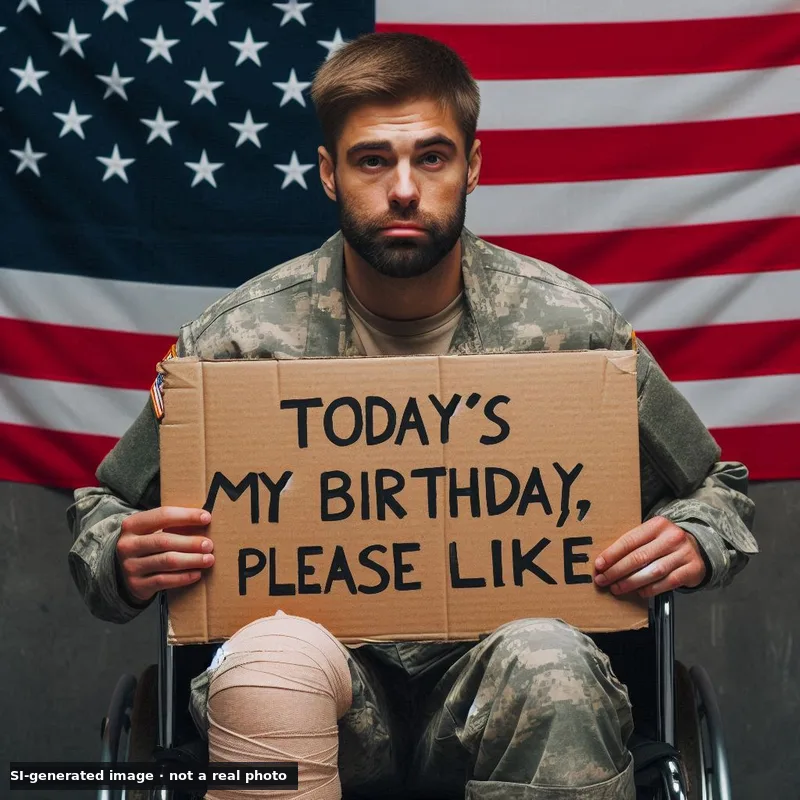
Result: 97% likely SI. The detector found a signed Content Credentials (C2PA) record and an IPTC tag declaring the file as SI-generated, and the pixels pointed the same way.
Metadata: PNG, 1,024 by 1,024 pixels, about 1.5 MB, no camera EXIF data. The Content Credentials record is signed by Microsoft, records a "created" action by "Image Creator from Designer" dated 4 October 2024, and gives the source type trainedAlgorithmicMedia, the IPTC term for media made by a trained model. The square 1,024 by 1,024 format is also a common generator output size.
What the test covers: this one Commons file. We did not test the Facebook posts described by Futurism, Atlanta News First or Snopes, and we cannot say what metadata, if any, they still carried.
This is the easy case, and we should say so. The file came almost straight from the generator, so its provenance label was still attached. A picture that has been downloaded, cropped or reposted on a social network usually loses that record, as we saw with the copy of the Trump duck image in our fact-check of a political SI meme. Our article on C2PA and Content Credentials explains what the record contains and why it is fragile. Without it, a verdict rests on the pixels alone, and Trielli's warning to WMAR applies: detection tools "can either give you false negatives… or give you false positives". A score is one signal, not proof.
The tells, and why they are fading
The older posts were easy to catch by eye. Futurism listed a flag patch with six stripes, a name tape made of blobs, blurry teeth and ears, four fingers on a glove and two legs ending in one boot. Atlanta News First found soldiers with six fingers, extra hands in the frame, name tapes reading "Amry", flags with too many or too few stars, and a plane full of veterans with no aisle. In May 2026, Lead Stories rated as fake a picture of a judge hugging an "88-year-old" Vietnam veteran, shared on X with a long story about waived fines; the judge's finger looked about to fall off, and the veteran's oxygen tube merged into his skin.
The picture we tested, made a few months after the "Babies adorable" post, shows how quickly some of these tells disappear. Its sign is perfectly legible, with clean hand-drawn lettering and a correctly spelled plea, where the June image produced gibberish. The face and hands are plausible at a glance. What gives it away is not a glitch but a lack of everything a real photo would have: no name tape, no readable unit insignia, no place, no date, no person who could be found.
That is the check that still works, whatever the generator:
- Look for a person, not a type. A real post about a veteran usually gives a name, a unit, a town or a link to a family, a hospital or a charity. The SI posts give none, which WMAR's sources and Futurism both noted.
- Look at the page, not the post. A page that posts a different wounded soldier every day, with the same caption, is a feed, not a family. Facebook's page transparency section shows where its managers are, which is how Atlanta News First found the Moroccan administrators.
- Search for the image. A reverse image search often shows the same "soldier" under several names, or the same scene with a different face.
- Read the details last. Flags, insignia, fingers and text are still worth a look, and our guide on how to spot SI images lists them, but a clean image is no longer evidence of a real one.
What to do when you see one
Trielli's advice to WMAR viewers was blunt: slow down, report the post if it breaks the platform's rules, "or you could also just close it." Commenting, even to say the image is fake, helps it spread. If the post comes from a relative, we would rather send a private message than argue under the post.
And if you want to support people who really served, the birthday post is the wrong address. Futurism made the point in June 2024: real disabled veterans deserve care and help, and a viral fake one draws attention away from them. A recognised veterans' organisation, or a veteran you actually know, will make better use of the gesture than a page run for likes.