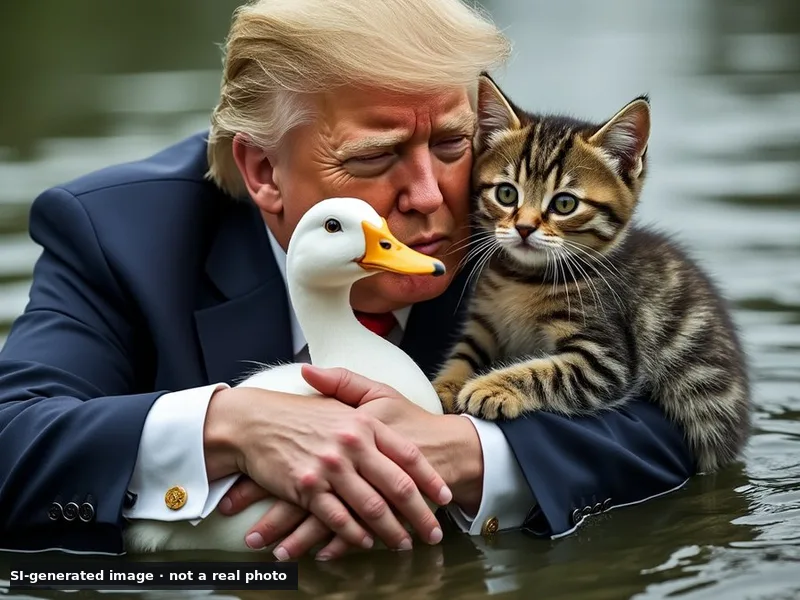
A man in a dark suit stands chest-deep in a lake. He has Donald Trump's face and hair, his eyes are half closed, and he hugs two animals against his chest: a white duck with an orange bill and a striped kitten that stares straight at the camera. On 9 September 2024, the X account of the House Judiciary Committee Republicans posted the picture with one line of text: "Protect our ducks and kittens in Ohio!"
Nobody took this photo. It was made by an SI (AI) image generator, and it was one of hundreds of generated pictures that turned a false rumor about Haitian immigrants in Springfield, Ohio, into a meme. This fact-check looks at the image, the claim behind it, and why a picture that fools nobody can still do the work of misinformation.
Claim: Haitian immigrants in Springfield, Ohio, are abducting and eating residents' pets and the ducks and geese in local parks; SI images showed Trump as the man who would protect the animals.
Verdict: the image is SI-generated and the claim is false. City officials and the Springfield police said they had no credible reports of pets being harmed by immigrants. PolitiFact rated the claim False, then rated Trump's debate version Pants on Fire. The copy of the image we tested scored 99% likely SI.
Where the picture came from
The post went up on Monday, 9 September 2024, the day before the presidential debate between Trump and Kamala Harris. NBC News reported that by that Friday it had more than 87 million views, which made it perhaps the most widely viewed of all the Springfield pet images. The committee Republicans did not answer NBC's request for comment.
The next day, at a committee meeting, Representative Eric Swalwell, a California Democrat, put a blown-up printout of the post on an easel and asked the chairman, Jim Jordan, "My God, are you ok?" Mediaite, which reported the exchange on 10 September, noted a small detail: in its view the bird is a goose, and the account had misidentified it as a duck. NBC News and PolitiFact both describe it as a duck. To us it looks like a white farmyard duck, but in a generated picture the question has no answer. There is no bird.
The image was never presented as a real photograph. It is too clean, too sentimental and too strange for that: a man in a suit and tie does not wade into a lake to cuddle a kitten. That is exactly what makes this case worth a fact-check. The picture was not meant to make people believe a scene. It was meant to make people believe a story.
The rumor the image was illustrating
The story was that Haitian immigrants in Springfield were stealing pets and wildlife to eat. The city's website estimated the immigrant population of Clark County, where Springfield sits, at 12,000 to 15,000 people. Since 2023, some Haitians have come through a federal parole program that lets them live in the United States legally. PolitiFact traced the rumor's main pieces on 9 September 2024:
- A secondhand Facebook post. A screenshot from a private Facebook group said that a neighbor's daughter's friend had found her cat butchered and hanging from a tree at a Haitian neighbor's home. As the Springfield News-Sun noted, the poster did not cite first-hand knowledge of any incident.
- A photo from another city. A picture of a Black man carrying a dead goose was shared as proof. According to an August Reddit post cited by PolitiFact, it was taken in Columbus, about 48 miles from Springfield.
- An arrest in another town. A video of a woman arrested for killing a cat was real, but it happened in Canton, about 173 miles away. PolitiFact found no evidence that the woman, Allexis Telia Ferrell, was a Haitian immigrant.
- A claim at a council meeting. At a city commission meeting on 27 August, a man who described himself as a social media influencer said immigrants were grabbing ducks in the park and cutting their heads off. He gave no evidence.
The city's answer was unambiguous. "There have been no credible reports or specific claims of pets being harmed, injured or abused by individuals within the immigrant community," Karen Graves, a city spokesperson, told PolitiFact and Lead Stories. She added that there were no reports of ducks or geese being killed either. Lead Stories quoted the Springfield News-Sun: the police division said it had "received no reports related to pets being stolen and eaten". PolitiFact rated the social media claim False.
On 10 September, Trump repeated it during the debate, in front of 67 million television viewers: "In Springfield, they're eating the dogs. The people that came in, they're eating the cats." Springfield's mayor, Rob Rue, had said at a city commission meeting the same day that there were no credible claims. PolitiFact rated the debate line Pants on Fire. JD Vance, Trump's running mate, wrote on X that "it's possible, of course, that all of these rumors will turn out to be false", and in another post, "Keep the cat memes flowing."
A flood of SI memes
The memes did keep flowing. NBC News reporter David Ingram wrote on 14 September that the rumor started in thinly sourced anecdotes, "but it really got going when AI-generated images and video that memeified the stories went viral". People used various apps, including Elon Musk's Grok, to make "cutesy and sometimes racist" pictures in seconds. Watermarks on at least two widely viewed videos showed they had been made with software from MiniMax, a Chinese SI start-up.
The duck and kitten post was only the most viewed. NBC counted others:
- An image posted by the activist Jack Posobiec of Trump running with a cat and a duck in his arms, chased by a group of Black men, at 1.3 million views.
- Another version of Trump holding two kittens while Black men chase him, reposted by @LibsofTikTok to 4.8 million views. It later reached Jimmy Kimmel's late-night show.
- A video of Trump kissing a duck on the head, captioned "I love you. I would never let the Haitians eat you", at 2.4 million views.
- Several pictures posted by Trump himself on Truth Social, including one of him in a private jet surrounded by animals.
A.J. Bauer, a journalism professor at the University of Alabama, gave NBC a practical reason why SI fit this story so well. Trump is famously not a pet person, and unlike other recent presidents he had no pet in the White House, so there were few real photos of him with animals. A generator filled the gap. "You no longer have to know a little bit of Photoshop," he said.
Some of the SI content was older than the rumor. PolitiFact found a Facebook video of cats in camouflage carrying weapons, presented as cats that had "taken back" Springfield. Its creator had first posted it on Instagram on 10 August 2024, with no link to Ohio, as "Navy SEAL Kittens". Generated material is cheap to make and just as cheap to relabel.
Not a deepfake, still misinformation
Most worries about SI in elections focus on the realistic deepfake: a fake voice, a fake video, a fake photo that people take for real. We explain that kind in our article on what a deepfake is. The Springfield images are a different animal. PolitiFact's Loreben Tuquero noted on 25 September 2024 that they "show scenarios that are implausible", and that people commenting on them talked "not on the images' authenticity, but on the underlying narrative".
That is the trick. Nobody needs to believe that Trump rescued a duck. The picture does its job if the viewer accepts the premise it is built on: that the animals of Springfield need rescuing. PolitiFact quoted one commenter, "I don't care if its AI…too cute!!!", and others who wrote as if the pet-eating story were established fact. Callum Hood, head of research at the Center for Countering Digital Hate, told PolitiFact that even unrealistic images become "a vehicle for the promotion of a particular message or narrative that is false or hateful or harmful".
Not every expert went that far. Darren Linvill, co-director of the Media Forensics Hub at Clemson University, told PolitiFact the images were "clearly meant to be satirical" and individually no more dangerous than a pen and ink drawing. The difference, he said, is scale: anyone with an internet connection can now make them. Vance, in an interview with CNN's Dana Bash quoted by PolitiFact, put it his own way: "If I have to create stories so that the American media actually pays attention to the suffering of the American people, then that's what I'm going to do."
The consequences were not virtual. Ohio's governor, Mike DeWine, said on 16 September 2024 that authorities had received at least 33 bomb threats in Springfield. None were valid, but schools, city buildings, grocery stores and clinics had to be evacuated or closed.
We tested the image
Wikimedia Commons hosts a copy of the committee's picture, 900 by 675 pixels, marked as public domain because it was made by software with no human author. We ran that file through our SI image detector, the same way a visitor would.
Result: 99% likely SI. The classifier found the statistical patterns of an SI-generated image in the pixels (classifier: SI 99%). The detector also flagged a face close-up and checked it in detail.
Metadata: JPEG, 900 by 675 pixels, about 111 KB, no camera EXIF data, no Content Credentials, no XMP tag declaring SI generation. Whatever the generator wrote into the file, if anything, did not survive the trip through X and Commons.
What the test covers: this one Commons file. We did not test the other Springfield images or videos described above.
The verdict matches what everyone already knew, so the useful part is the metadata. This copy carries nothing that says "made by SI". That is the normal state of a picture that has been posted, downloaded and reposted: labels such as Content Credentials, which we explain in our article on C2PA and Content Credentials, rarely survive social networks. Only the pixels and the context are left.
The pixels have a few tells you can check without any tool:
- The hands. Where they meet over the duck, the fingers form a knot in which it is hard to say which finger belongs to which hand.
- The water. The man is in a lake up to his chest, yet the white shirt cuffs, the gold cufflinks and the kitten's fur are perfectly dry a few centimetres above the surface.
- The finish. Soft, even light, a blurred background with no shoreline, skin and feathers with the same polished texture: the look of a generated picture rather than a press photo.
None of these clues proves anything on its own, and a score is never proof either, as we explain in our article on whether SI detectors are accurate. Here, the strongest evidence is not in the image at all. It is the absence of any real event.
How to read the next political SI meme
The Springfield episode was not the last time an SI picture of Trump spread with a political message. Three weeks later, after Hurricane Helene, a generated image of him wading through floodwater did the rounds. And the economics are the same as for the apolitical spam we covered in our fact-check of Shrimp Jesus: a generated picture costs nothing, so the only question is how far it travels.
- Separate the picture from the claim. Ask what the image is asking you to accept. Here, the image was obviously fake, and the claim it carried was the part that needed checking.
- Look for a first-hand source. A friend of a neighbor's daughter is not one. A police report, a court record or an official statement is.
- Check where the "proof" comes from. The goose photo came from Columbus, the cat video from Canton. A reverse image search is often enough to find out.
- Look at the hands and the edges. Our guide on how to spot SI images lists the common flaws.
- Run a quick check. If you are not sure, check for SI with a detector. It gives one more signal, especially on pictures that look like news photos. It does not tell you whether the story is true.
PolitiFact cited a 2023 study by researchers at the University of Waterloo and Carleton University in which 260 participants sorted 20 images of people into real and fake, with an average accuracy of 61%. Most of us are worse at this than we think. If you want to know where you stand, try the SI or Not game.