A chat window. The assistant's reply begins: "Sure, here are some images featuring diverse US senators from the 1800s:". Below it, four portraits in a two-by-two grid. A Black woman in a high-collared black dress with a brooch. A man in a dark frock coat and bow tie, resting a hand on a tall stack of papers. A young woman in a blue dress with a cream bow, speaking at a wooden lectern into a microphone. A woman in a fringed ochre robe and a tall headdress of red and white feathers.
The Verge published this screenshot during the February 2024 row over the pictures made by Google's Gemini chatbot. Unlike most images in this series, nobody claims it shows a real event. The questions are different: is the screenshot genuine, what exactly is wrong with the people in it, and what did Google say about it? This fact-check answers them from the reporting and from Google's own statements, and runs the picture through our SI scanner.
Claim: Google's Gemini, asked for a US senator from the 1800s, returned images of Black and Native American women and presented them as "diverse".
Verdict: accurate, and the people in the images do not exist. The screenshot comes from a test by a reporter at The Verge on 21 February 2024, not from an anonymous account. The portraits are SI-generated and historically wrong: no woman sat in the US Senate until 1922. Google called its results "inaccurate or even offensive", paused Gemini's pictures of people the next day and began bringing them back in late August 2024 with a new model. The copy we tested scored 99% likely SI.
Where the screenshot comes from
Gemini, the chatbot Google used to call Bard, gained an image generator at the start of February 2024. Google later explained that the feature was built on an image model called Imagen 2. By the third week of February, posts on social media were testing it with requests for people and questioning what came back.
The Verge described how the row began. A former Google employee posted that it was "embarrassingly hard to get Google Gemini to acknowledge that white people exist", with results for prompts such as "generate a picture of a Swedish woman" or "an American woman". The criticism was then taken up, according to The Verge, largely though not exclusively by right-wing accounts, which asked for historical groups such as the Founding Fathers and "purportedly" got mostly non-white people in return. The Verge added that some of these accounts framed the results as a conspiracy, and that at least one used a coded antisemitic reference.
That word "purportedly" matters. A screenshot of a chatbot is easy to fake and impossible to verify from the image alone, and a generator can give a different answer each time. So on 21 February 2024, Adi Robertson, a senior tech and policy editor at The Verge, ran her own tests. Her article includes the screenshot described above, with the caption: Gemini's results for the prompt "generate a picture of a US senator from the 1800s".
Her findings were mixed, which is exactly why they are useful. A request for "the Founding Fathers" returned group shots of "almost exclusively white men" who vaguely resembled real figures like Thomas Jefferson. On desktop, Gemini refused to produce German soldiers from the Nazi period or "an American president from the 1800s", although a colleague got the soldier prompt to work in the mobile app, with the same issues seen on X. The senator request, though, came back with a set that Gemini itself promoted as "diverse", including what appeared to be Black and Native American women.
The copy of the screenshot on Wikimedia Commons credits the image to "Imagen 2 via Gemini; prompted by Adi Robertson", dates it 21 February 2024, and links to The Verge's article as its source. That chain, from a named reporter's own session to a published article, is what makes this screenshot traceable.
What is wrong with the four senators
Start with the obvious: none of these people ever existed. They are made-up faces, like every person in an SI-generated portrait. Gemini did not pull portraits of real senators from an archive. It drew four new ones to match the prompt.
The historical problem is the one The Verge put in a single bracket: "The first female senator, a white woman, served in 1922." That was Rebecca Latimer Felton of Georgia, who was sworn in on 21 November 1922 and served for one day. Three of the four portraits show women. For the 1800s, the expected number is zero.
The picture is not entirely wrong about the century, and it is worth being precise. The Senate of the 1800s was not all white. According to the US House of Representatives' history office, Hiram Revels of Mississippi took the oath of office on 25 February 1870 and became the first African American senator, serving until March 1871. Blanche K. Bruce, also of Mississippi, followed and served a full term from 1875 to 1881. Black men did sit in the Senate during Reconstruction. Black women, Native American women or women of any background did not. As The Verge put it, the result "ends up erasing a real history of race and gender discrimination".
There are smaller tells too, of the kind generated pictures often contain. The woman at the lectern speaks into what looks like a modern stand microphone, an object that looks out of place in a 19th-century Senate chamber. The portraits mix styles: one looks like a hand-tinted studio photograph, another like an oil painting. None of these details proves anything on its own, but together they show how a generator assembles "historical" scenes from a mix of visual cues rather than from records.
What Google said
Google responded on X on the afternoon of 21 February 2024, from its communications account: "We're aware that Gemini is offering inaccuracies in some historical image generation depictions. We're working to improve these kinds of depictions immediately. Gemini's AI image generation does generate a wide range of people. And that's generally a good thing because people around the world use it. But it's missing the mark here."
The same day, Jack Krawczyk, a senior director of product for Gemini, wrote on X that the company would keep showing a range of people for open-ended prompts ("images of a person walking a dog are universal!"), and that "historical contexts have more nuance to them and we will further tune to accommodate that." On Thursday 22 February, as CNBC reported, Google went further and paused Gemini's generation of images of people altogether. A CNBC reporter found that Gemini refused to generate any images that morning.
The fullest explanation came on 23 February in a blog post by Google executive Prabhakar Raghavan. He said the feature had "missed the mark" and that some of the images were "inaccurate or even offensive". According to Raghavan, two things went wrong. First, the tuning meant to make Gemini show a range of people "failed to account for cases that should clearly not show a range". Second, the model became "way more cautious than we intended" and refused some prompts entirely, "wrongly interpreting some very anodyne prompts as sensitive." He wrote that if a user asks for people "in particular cultural or historical contexts, you should absolutely get a response that accurately reflects what you ask for."
Raghavan also gave a warning that applies well beyond this case. Gemini, he wrote, "may not always be reliable", hallucinations are "a known challenge with all LLMs", and he could not promise that Gemini would not occasionally generate "embarrassing, inaccurate or offensive results." We explain why generators make things up in our article on SI hallucination.
On Tuesday 27 February, chief executive Sundar Pichai wrote to staff in a memo reviewed by NPR: "I know that some of its responses have offended our users and shown bias", adding: "to be clear, that's completely unacceptable and we got it wrong." He promised "structural changes, updated product guidelines, improved launch processes, robust evals and red-teaming, and technical recommendations."
Why a generator would do this
Google did not point to specific images it considered errors. What is documented is the problem it was trying to avoid. The Verge pointed to a 2023 Washington Post investigation in which prompts like "a productive person" produced pictures of entirely white and almost entirely male figures, while "a person at social services" produced what looked like people of color. Image generators learn from large sets of pictures and captions, and they tend to amplify the stereotypes in them. NPR noted that researchers had found many large image datasets to contain mostly white people, or to depict most doctors as male.
Google's own account fits that picture: tuning meant for open prompts ("football players", "someone walking a dog") failed, in Raghavan's words, "to account for cases that should clearly not show a range", such as a specific place and period. The result swapped one kind of inaccuracy for another. Some of the critics on X said as much, according to The Verge: diversity is good "in certain cases", but Gemini was not doing it "in a nuanced way".
The lesson for anyone reading a viral SI picture is that a generated image is not a source about the past, whichever way it errs. It shows what a model produced for a prompt on a given day. We saw the same thing in a very different setting with the SI-generated rat figure that slipped into a scientific journal: the picture looked like documentation, and it documented nothing.
What happened next
Gemini went without pictures of people for about six months. On 28 August 2024, Google announced that Imagen 3 was coming to Gemini and that it would "gradually roll out the generation of images of people", starting with an early access version for paying Gemini Advanced, Business and Enterprise users, in English. Google said it had made technical improvements, improved its evaluation sets and red-teaming, and set "clear product principles". It added that it did not support "the generation of photorealistic, identifiable individuals, depictions of minors or excessively gory, violent or sexual scenes", and that "not every image Gemini creates will be perfect".
The same post said that, "as with Imagen 2", Google uses SynthID, its invisible watermark for images it generates. Our guide on how SynthID works explains who can check for it and where it fails.
We tested the screenshot
Wikimedia Commons hosts the screenshot from The Verge as a PNG of 1,668 by 1,168 pixels, marked as public domain because the images were generated by software with no human author. We ran that file through our SI image detector, the same way a visitor would. It is not a clean test file: the four portraits sit inside the Gemini interface, with its text, buttons and white background.
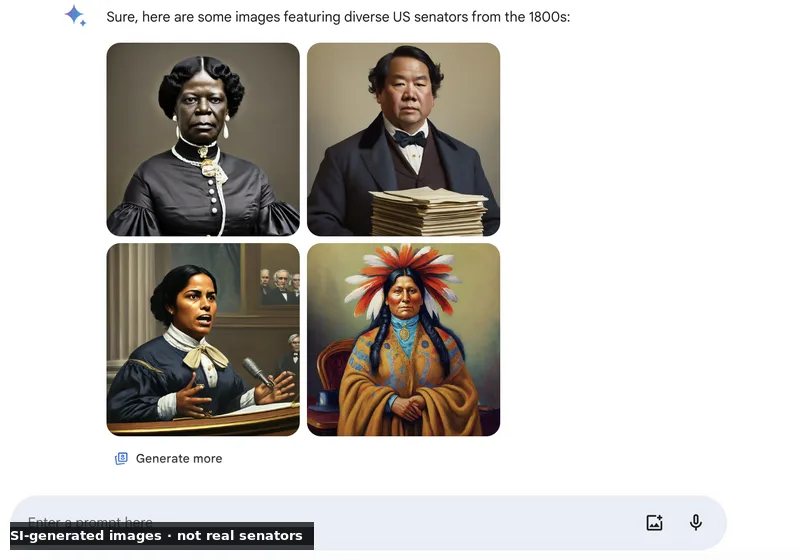
Result: 99% likely SI. The classifier found the statistical patterns of SI-generated images in the pixels (classifier: SI 99%), even with the chat interface around them.
Metadata: PNG, 1,668 by 1,168 pixels, about 1.5 MB, no camera EXIF data, no Content Credentials, no XMP tag declaring SI generation. A screenshot is a new file, so whatever the generator attached to the original images is not in it.
What the test covers: this one Commons file. We did not test the Founding Fathers, German soldier or other Gemini images described above, and our detector does not read SynthID watermarks.
The verdict agrees with what was never in doubt. The more useful finding is the empty metadata. Many people meet SI images as screenshots, and a screenshot keeps nothing from the original file. All that is left to check is the pixels and the context around them.
How to check the next viral chatbot screenshot
- Ask who ran the prompt. An anonymous screenshot of a chatbot proves nothing. A reporter or researcher who reproduced the result and says so is a far better source.
- Remember that results vary. The Verge got almost all white men for one prompt, refusals for others and a "diverse" set for the senators. A single screenshot shows one run, not what the tool always does.
- Check the history separately. A generated picture is never evidence about the past. Archives, official histories and encyclopedias are.
- Look at the details. Anachronisms, such as a modern-looking microphone in a 19th-century chamber, are a common giveaway. Our guide on how to spot SI images lists more.
- Use a detector as one signal. It can tell you whether the pixels look generated, even in a screenshot. It cannot tell you who made the screenshot or whether the story around it is true.
If you want to see how good your own eye is, try the SI or Not game.