On 22 September 2026, the most common acronym in technology got a rival. Speaking at the United Nations General Assembly, US President Donald Trump said the US government would stop saying "artificial intelligence" and use "super intelligence" instead. Within hours, a State Department bureau told its staff to write "SI" where they used to write "AI". This article looks at the news itself and, above all, at its consequences: who has to change their vocabulary, who does not, and what stays exactly the same. If you only want the definition, our guide on what is SI covers the meaning, the history of the word and the difference with superintelligence.
What happened, step by step
The renaming happened fast, and most of it is documented by a small number of reports. Here is what those reports agree on.
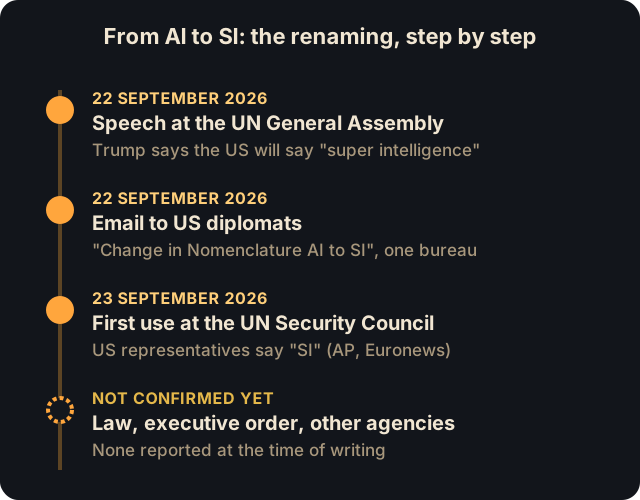
The speech at the UN
In his address to the General Assembly in New York, Trump argued that the word "artificial" does the technology a disservice. According to the Associated Press, he said that "the use of the word artificial makes intelligence fake, it makes it sound fake and it is not fake. It's actually amazing." Gizmodo quotes the core announcement: "From this point forward, all of United States documents and hopefully the world's, will be changed to use the much more accurate term Super as opposed to Artificial." He also admitted some doubt about how far his decision would reach: "Let's see if I have any power. Maybe I do and maybe I don't."
The same speech carried a policy message. AFP reports that Trump said the United States "totally rejects any attempt to construct a globalist scheme to control" the technology, at an Assembly where AI safety was a central topic.
The email to diplomats
The same day, the Associated Press obtained an email titled "Change in Nomenclature AI to SI". It was sent by Michael Drager, deputy assistant secretary of state in the Bureau of International Organization Affairs, the office that runs US missions to the UN and other multilateral agencies. The instruction was short:
"Following the president's remarks at the GA today, please change all references of 'Artificial Intelligence' to 'Super Intelligence' in our documents and positions."
The email added that the bureau would use "SI" in all remarks, positions and press elements from then on.
First use in diplomacy
The next day, US representatives used the new term at a UN Security Council meeting on the risks of the technology, according to AP and Euronews. That is the first documented use of "SI" by US officials in an international setting.
What the renaming is, legally speaking
The word "officially" appears in many headlines, so it is worth being precise about the status of the change as it stands on the day of this article.
- A presidential announcement. The change was declared in a speech, not written into a statute.
- An internal instruction in one bureau. The only written guidance reported so far is the State Department email above. The AP noted that it was unclear whether other bureaus had received, or would receive, the same order, and whether the change would apply across the federal government.
- No law or executive order reported. None of the reports we reviewed describes a bill or a formal executive order defining the new term.
- No international adoption. Euronews points out that other countries have not recognised the terminology change, much as they did not follow earlier US renamings.
Status can change. A new name that starts in one bureau can spread through guidance, style guides or an executive order. We will update this article if an official text appears. Until then, "SI" is the preferred term of the US government in its international communications, not a legal definition.
What does not change
The easiest mistake is to read a new word as a new technology. The renaming leaves most things exactly where they were.
The technology
No model was retrained on 22 September. ChatGPT, Gemini, Claude, Midjourney and Stable Diffusion work the same way under either name. Their strengths are the same, and so are their weaknesses: invented facts, confident errors and output that is hard to tell from human work.
The law outside the US
The European Union's AI Act, officially Regulation (EU) 2024/1689 laying down harmonised rules on artificial intelligence, entered into force on 1 August 2024. According to the European Commission, it became applicable on 2 August 2026, with some exceptions and later deadlines for certain high-risk systems. A vocabulary decision in Washington does not amend a European regulation. Companies that sell in Europe keep the same obligations, written with the same words.
The science and the standards
Research papers, university courses and technical standards use "artificial intelligence" and "machine learning". Nothing in the reports suggests that the research community, or standards bodies such as the C2PA coalition behind Content Credentials, intend to rename their work.
The risks
Synthetic photos, cloned voices, fake reviews and generated essays are exactly as common as they were the week before. A new label does not make any of them easier to spot.
| Area | Changes? | What we know |
|---|---|---|
| US State Department wording | Yes | One bureau told staff to write "Super Intelligence" and "SI" in documents, positions and press material. |
| Other US agencies | Unclear | No reported instruction beyond that bureau at the time of writing. |
| US law | No | No law or executive order reported. |
| EU AI Act and other foreign laws | No | Same text, same obligations, same vocabulary. |
| The technology | No | Same models, same abilities, same limits. |
| Public vocabulary | Partly | People now meet "SI" in news and speeches; "AI" remains the dominant word worldwide. |
Consequences for different audiences
Even without a law behind it, a term used by the US government in diplomacy ends up in news stories, reports and search boxes. Here is what that means in practice.
For everyday readers
You will see "SI" in quotes from US officials and in coverage of US diplomacy, often next to "AI" in the same article. When you read "SI" in that context, you can read "AI". When you read "superintelligence" in a book or a statement from a research lab, it usually means something else: a hypothetical system far beyond human ability. Keeping the two apart avoids a lot of confusion.
For companies and organisations
Businesses are not bound by the State Department's style choices. What they will notice is a vocabulary gap: documents from one part of the US government may say "SI" while contracts, laws and technical documentation say "AI". Teams that write proposals, policies or public statements will likely want to mention both terms, at least while it is unclear how far the new name spreads.
For newsrooms and writers
Journalists now have to quote officials who say "SI" while their readers mostly say "AI". The practical answer, used by much of the coverage so far, is to quote the new term and explain it once. The acronym is also crowded, as the next section shows, so a first mention in full ("super intelligence, or SI") helps.
For search and online vocabulary
People who meet a new term look it up. Queries such as "what is SI" or "SI meaning" now mix three audiences: people curious about the renaming, students looking for the International System of Units, and sports fans looking for Sports Illustrated. For anyone publishing online, the lesson is to use the new term alongside the old one, because most people still search with "AI".
For SI detection
This is where the renaming matters for us. An "AI detector" and an "SI detector" are the same tool with two names: software that estimates whether an image, a text or a recording was made by a generative model. On this site we write SI first, because that is now the US government's term, and AI alongside it, because that is what most people type. Our free SI detector works exactly as it did before the renaming. The SI image detector combines a pixel classifier with EXIF, XMP and C2PA Content Credentials, and the SI text detector analyses writing style sentence by sentence. Like every AI detector, they give probabilities and clues, not proof.
A crowded acronym
"SI" already had a busy life before September 2026. It is the usual abbreviation of the International System of Units, the name of the magazine Sports Illustrated, and the chemical symbol for silicon when written "Si". Inside government, it has another meaning. HuffPost quoted former intelligence official Marc Polymeropoulos, who wrote that "SI means special intelligence, ie communication intercepts" and warned that the change "is gonna screw everyone up".
That collision explains why so many articles spell the term out. It also explains why "SI" on its own, without context, is a poor search query: the results will depend on what the search engine guesses you meant.
Criticism and context
The announcement drew mockery online and criticism from unexpected places. Gizmodo reports that conservative commentator Matt Walsh called the effort "bizarrely dystopian" and "the stupidest thing to focus on right before an election with gas prices through the roof."
The renaming also fits a pattern. Gizmodo lists earlier renamings by the same administration, including the Gulf of Mexico as the "Gulf of America" and the Department of Defense as the "Department of War". Some of those names were adopted by map services, others were ignored abroad.
The larger debate at the UN was not about the name at all. AFP reports that more than 20 countries, mostly European, called for binding safety measures for advanced systems before the Assembly, and that UN Secretary-General Antonio Guterres called for dialogue between the United States and China on the technology. The US position, restated in the same speech as the renaming, was to reject international control. In other words, the new word came with a clear policy message: encourage the technology, do not constrain it.
What to watch next
Four questions will decide whether "SI" becomes a lasting term or a footnote:
- Does it spread inside the US government? Watch for similar instructions in other State Department bureaus or other agencies, and for any executive order that defines the term.
- Does it reach US law? Existing and future bills use "artificial intelligence". A change there would be a much bigger signal than a style instruction.
- Do companies follow? Model providers, cloud platforms and software vendors describe their products as AI. Any shift in their marketing would show whether the term has commercial weight.
- Do other governments react? So far they have not adopted it. International texts, including UN documents and the EU AI Act, still use "AI".
Our approach. We use "SI" first and "AI" as a synonym, and we keep "superintelligence" for the hypothetical systems it has always described. If the status of the new term changes, this article and our guide on what SI means will be updated.